

Contact
Write to Us And We Would Be Happy to Advise You.
Do you have any questions, or would you like to speak directly with a representative?
By Fariha
Niceone-Keypad supports low MOQ membrane switch orders for startup hardware founders, R&D buyers, distributors, and OEM teams that need custom HMI parts before committing to mass production. If your project needs 50–100 membrane switches for pilot testing, field validation, distributor samples, or first production assembly, our team can review the drawing, material, IP rating target, tactile design, connector, and batch plan before quotation.
Low MOQ does not mean “one standard part fits all.” A simple graphic overlay or tactile membrane keypad is different from a PCB-based membrane switch with LED backlighting, FPC tail, sealing gasket, and custom connector. This page explains how small-batch membrane switch orders work, what affects cost, and what to send so Niceone can quote accurately.
Niceone-Keypad manufactures custom membrane switches in Dongguan, China, with US office support in Redding, Connecticut. Buyers can start with a low-volume build, validate fit and function, then scale the same design into repeat production.
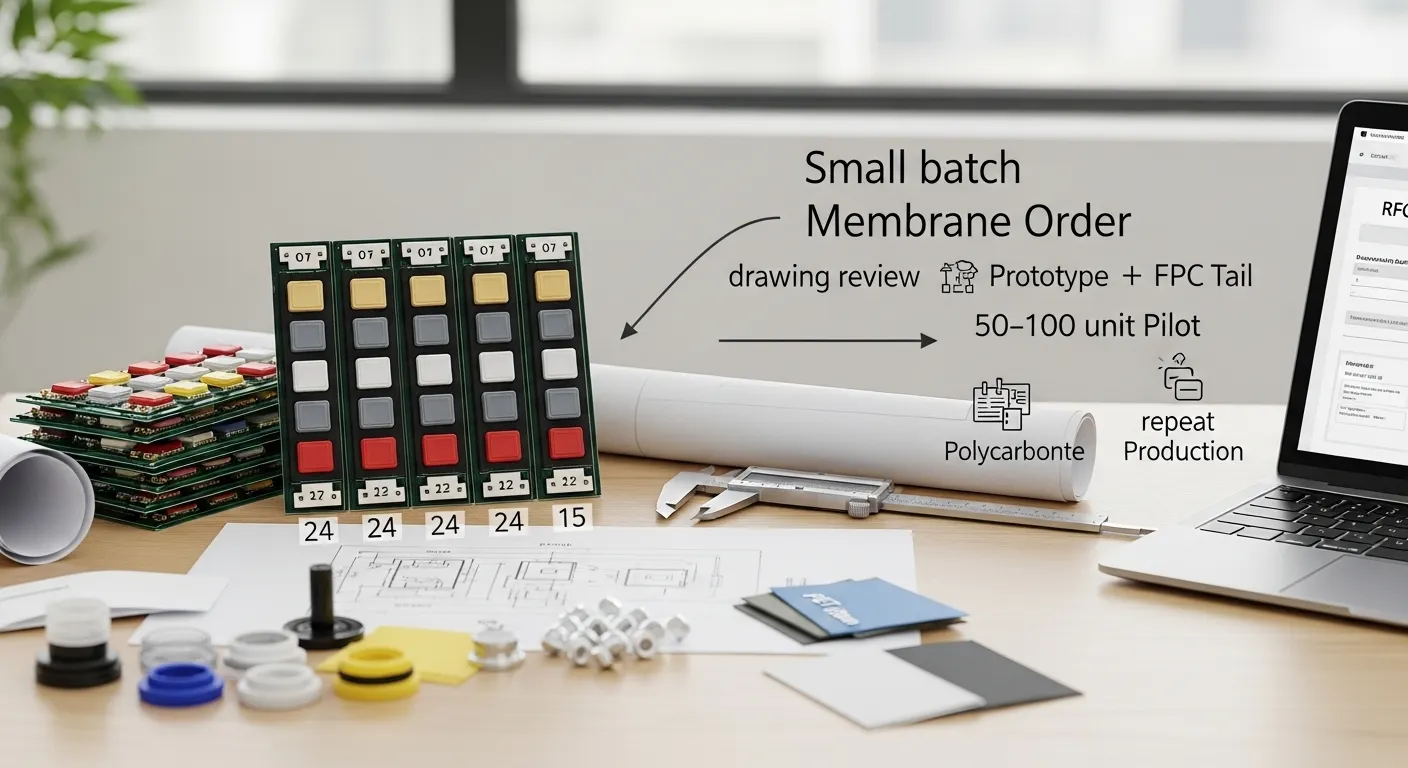
Yes. Niceone-Keypad can support low MOQ membrane switch projects starting from 50–100 units for standard small-batch orders, depending on the design. This is useful when your team needs a real production-style part, but your project is not ready for a 1000+ unit production run.
Typical low-MOQ buyers include:
For highly customized OEM builds, the practical MOQ may change. A sealed, backlit, PCB-mounted membrane switch with a custom connector has different setup requirements than a simple PET overlay with printed silver circuitry.
For buyers comparing China-based suppliers, Niceone’s Dongguan factory and US office support help bridge the gap between flexible manufacturing and clear communication. You can learn more about our production background here: Niceone’s membrane switch manufacturing in Dongguan.
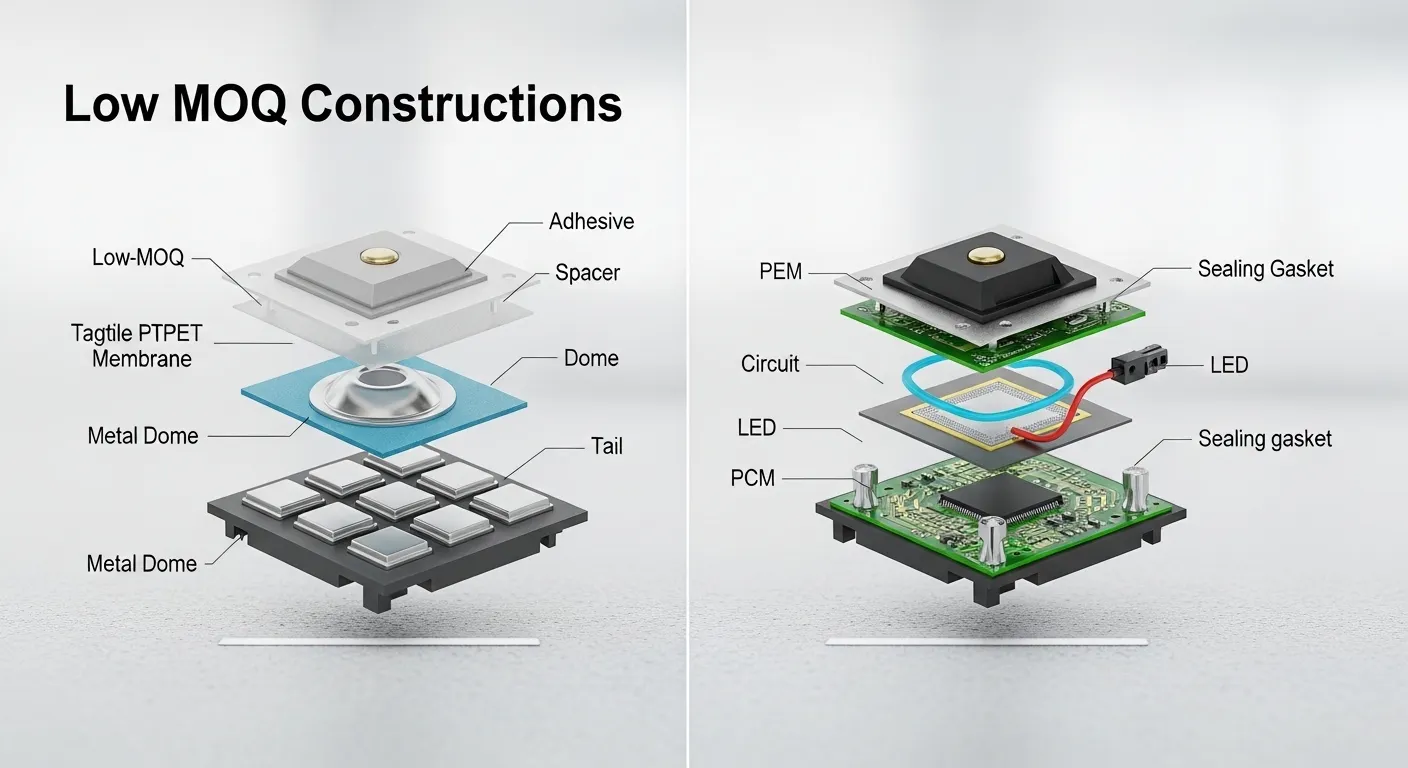
A standard low-MOQ order usually means the design uses common membrane switch materials and a manageable construction. These projects often have fewer tooling risks and faster engineering review.
A standard small-batch order may include:
A custom OEM order may need separate review if it includes more complex requirements, such as:
These options are available by project specification, but they can affect MOQ, price, sample cost, and production planning. That is why Niceone reviews low-MOQ projects by design rather than treating every inquiry as the same product.
A low-volume membrane switch often costs more per piece because the setup work is spread across fewer units. The factory still needs to review artwork, confirm dimensions, prepare production files, source materials, set up printing, cut layers, assemble the switch stack, inspect the parts, and pack the order.
Small-batch pricing is affected by:
A 50-unit order is often used to reduce project risk, not to achieve the lowest unit price. The goal is to confirm design, assembly fit, user feel, and market readiness before a larger batch.
The table below shows how buyers should think about quantity planning. Exact pricing depends on drawing, materials, construction, and inspection requirements.
| Quantity range | Best use case | Price behavior | Design flexibility | Quote note |
|---|---|---|---|---|
| 50 units | Prototype validation, demo units, startup pilot | Highest unit cost because setup is spread over fewer parts | Good for simple or moderately custom designs | Best when you need real parts before a larger decision |
| 100 units | Pilot build, distributor samples, field testing | Lower unit cost than 50, but still small-batch pricing | More practical for tactile switches, overlays, and simple LED designs | Good balance between risk control and usable test quantity |
| 500 units | First production batch or controlled market launch | Setup cost spreads better across the order | Better for custom connectors, sealing, or repeatable assembly | Useful when the product design is already approved |
| 1000+ units | Mass production or repeat OEM supply | More efficient unit pricing | Full customization becomes easier to justify | Best after prototype and pilot approval |
For first-time importers, the smartest path is often not the cheapest single unit price. It is a controlled path from sample to pilot to repeat production.
A low-MOQ project becomes easier to quote when the first version avoids unnecessary complexity. You can still build a professional membrane switch, but every special feature should have a real reason.
To keep a 50–100 unit batch practical, consider:
For lab equipment and test instruments, small batches often need clean graphics, accurate button layout, and reliable tactile response before larger production. See related application guidance here: instrumentation membrane switches for lab equipment.
Low MOQ should not force the wrong construction. If the application needs higher electrical, mechanical, or environmental performance, the design should reflect that from the beginning.
Choose FPC when the switch needs dense routing, flexible assembly, or more advanced circuit layout than printed silver can support.
Choose a PCB-based membrane switch when the panel needs stronger support, mounted components, connector stability, or a more rigid assembly.
Choose LED backlighting, light guide film, or fiber optic backlighting when the operator must read the panel in dark rooms, outdoor conditions, vehicle cabins, marine consoles, or industrial equipment.
Choose IP-rated construction when dust, water spray, washdown, humidity, or outdoor exposure can affect the keypad. For wet or marine-style environments, review waterproof design expectations carefully. Related guidance is available here: marine membrane switch panel design guidance.
Choose ESD or RFI shielding when the membrane switch is used near sensitive electronics, communication equipment, test systems, or control panels.
Lead time depends on design readiness, not only quantity. A complete RFQ with drawings, artwork, quantity, material preference, connector details, and environmental requirements can move faster than an incomplete request.
| Order stage | Buyer input needed | Niceone review or production step | Common delay risk |
|---|---|---|---|
| RFQ review | Drawing, quantity, application, target specs | Engineering checks design feasibility and quote scope | Missing dimensions or unclear connector details |
| Artwork / DFM confirmation | Vector artwork, color reference, button layout | Confirm overlay, print, layer stack, tail, and adhesive | Artwork revision or unclear icons |
| Sample or pilot approval | Approved drawing and purchase details | Produce parts for test, assembly, and inspection | New feature changes after approval |
| Repeat order | Confirmed revision and quantity | Reproduce approved design with agreed updates | Revision control or material changes |
For low-MOQ orders, the best way to avoid delay is to decide which features are required now and which can wait until the next revision.
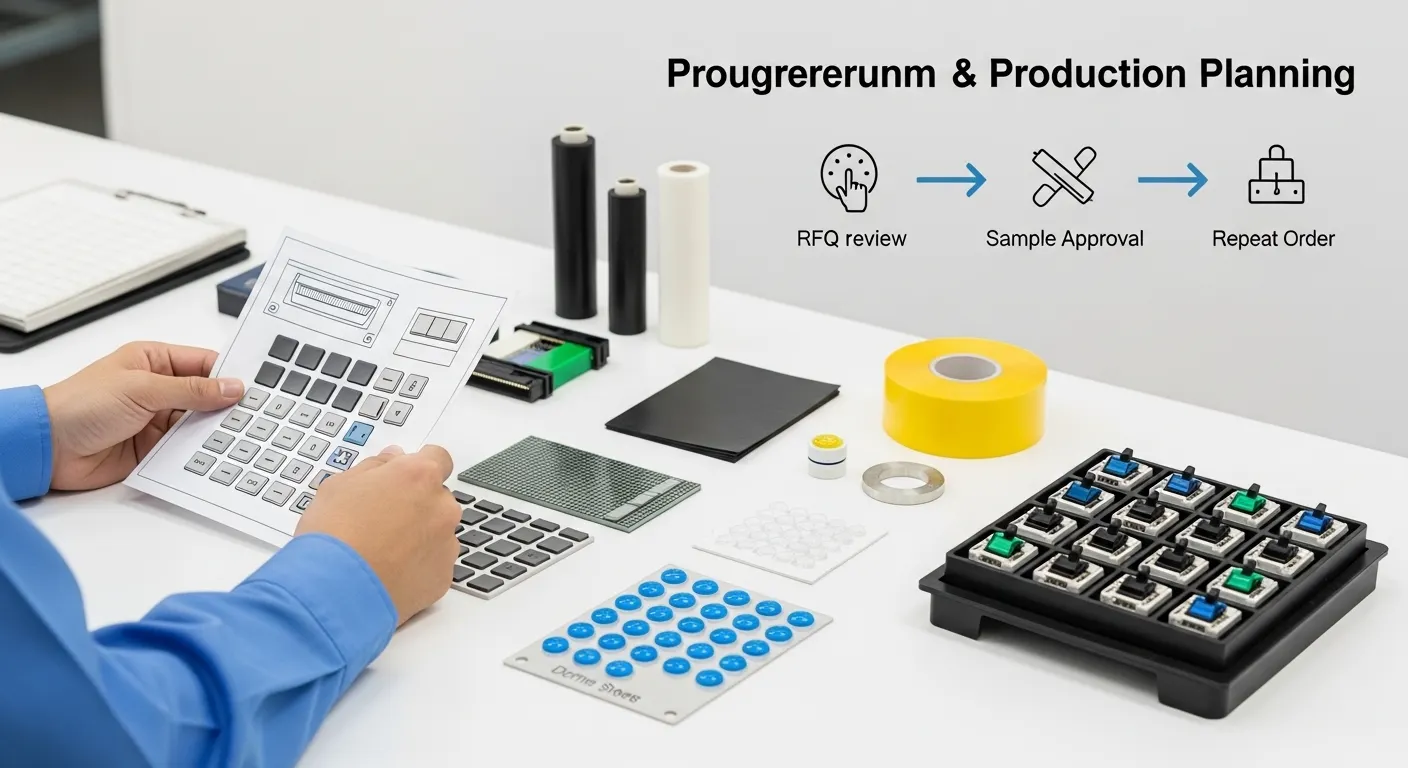
A strong RFQ helps Niceone quote the right construction and avoid assumptions. Send as much of the following as possible:
If you are unsure which construction is best, send the application and quantity first. Niceone’s team can recommend a practical build path.
Low-MOQ membrane switch sourcing is not only about finding the lowest minimum quantity. The supplier should help you avoid an expensive design mistake before the product reaches production.
Niceone-Keypad can support the early buying stage with custom design review, prototype planning, membrane switch production, graphic overlay manufacturing, silicone rubber keypad options, FPC and PCB membrane switch construction, backlighting solutions, and waterproof design support.
The Dongguan factory gives buyers access to custom manufacturing. The Connecticut office helps US buyers communicate project requirements, clarify RFQ details, and move from small batch to repeat order with less friction.
For a startup, distributor, or OEM buyer, this matters because the first 50–100 units often decide the next step. The part must fit the enclosure, feel right to the operator, match the artwork, connect properly, and survive the intended environment.
Yes, Niceone-Keypad can review 50-unit low-MOQ projects for standard small-batch builds. OEM designs with complex backlighting, FPC, PCB, sealing, or special connectors may need a custom MOQ review.
The setup work is similar whether the order is 50 units or 1000 units. Artwork review, material preparation, printing, cutting, assembly, inspection, and packing are spread across fewer parts.
Yes, these features can be specified by project. However, tactile domes, LED backlighting, IP-rated sealing, FPC, PCB, and custom connectors can affect price, MOQ, and production planning.
Send a drawing, dimensions, artwork, target quantity, material preference, button layout, connector details, adhesive surface, and operating environment. If you have an existing sample, photos can also help.
For new designs, prototypes are useful before a pilot batch. They help confirm fit, graphics, tactile feel, connector position, and assembly before ordering more units.
Yes. Keep the approved drawing, artwork, revision number, and specifications clear. Niceone can use the confirmed design as the basis for larger repeat orders after pilot approval.
Send your drawings, target quantity, panel dimensions, artwork, connector details, tactile requirements, backlighting needs, and IP-rating target to Niceone-Keypad for a low MOQ membrane switch quote. Our Dongguan factory and CT office can help you review the build, confirm the right construction, and plan the path from 50–100 units to repeat production.
Do you have any questions, or would you like to speak directly with a representative?

