

Contact
Write to Us And We Would Be Happy to Advise You.
Do you have any questions, or would you like to speak directly with a representative?
By Fariha
Niceone-Keypad’s membrane switch prototype service is designed for OEM design engineers and hardware teams who need functional samples — 1 to 50 units — before committing to full production tooling. If your design is finalized or near-final and you need physical samples to validate overlay graphics, circuit routing, tactile feedback, and dimensional fit, this page covers what to prepare, what realistic lead times look like by complexity tier, and what to test when the prototype lands on your bench.
Prototyping through the same Dongguan factory that handles your production run eliminates supplier handoff risk. Our Connecticut office handles US-timezone communication for file review, revision feedback, and quote clarification — so you’re not managing a 12-hour time gap on your own.
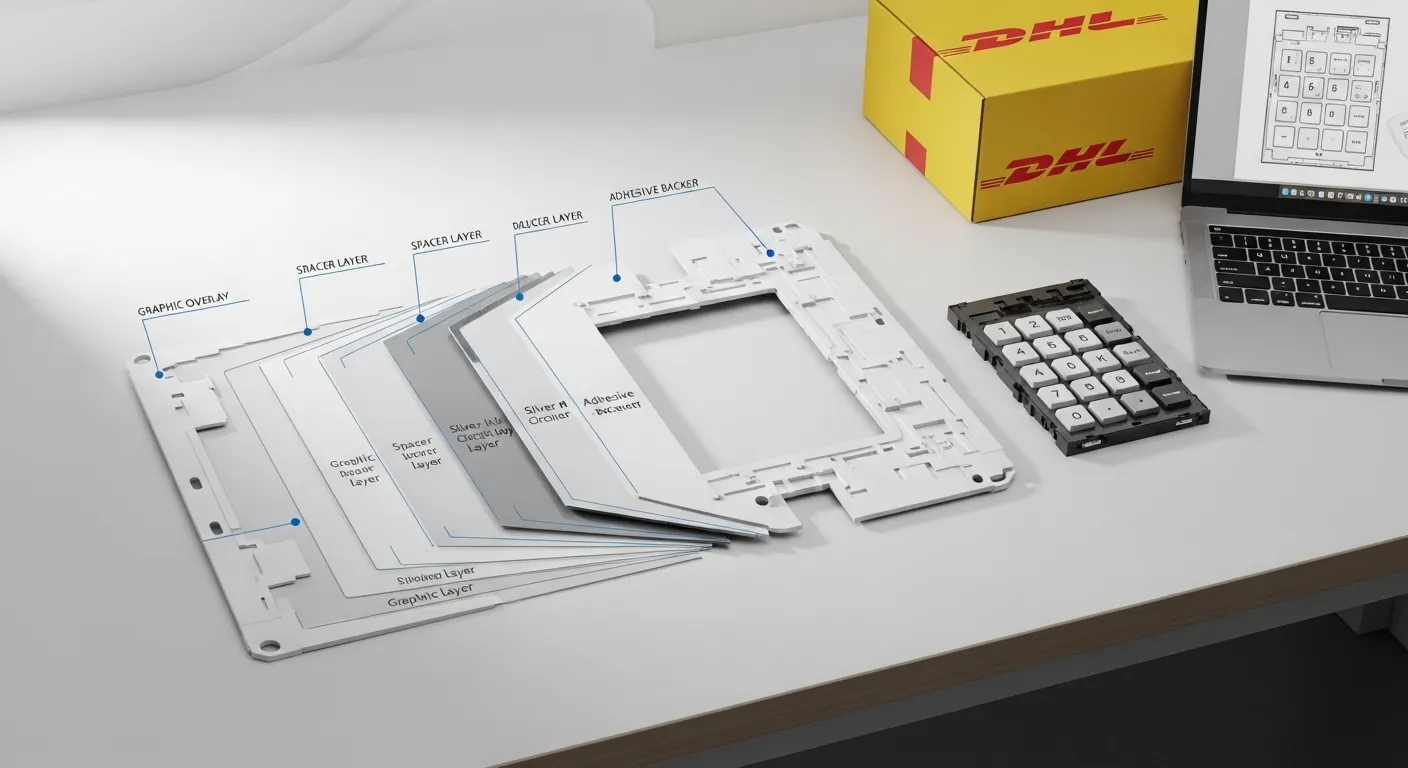
Not every order needs a functional prototype. Re-orders of existing designs with no layout or material changes can typically go straight to production. A full functional prototype — complete circuit assembly, overlay, adhesive, and connector — is the right call when:
A cosmetic sample — overlay only, no circuit — is faster and cheaper when you only need to validate printed graphics, Pantone color matching, emboss height, or surface texture before approving the full build. If you’re still finalizing your layer stack-up or trace routing, review Niceone’s membrane switch engineering design rules before ordering a prototype to avoid a re-spin.
Incomplete design submissions are the most common cause of prototype delays. Before submitting an RFQ, prepare the following:
Lead time depends directly on assembly complexity, not just switch count. The table below shows typical production windows from design approval to shipment from our Dongguan facility. DHL international transit adds 3–5 business days.
| Prototype Type | Circuit Substrate | Typical Lead Time | Key Input Required |
|---|---|---|---|
| Graphic overlay only | No circuit | 3–5 business days | Vector art, Pantone refs |
| Standard membrane switch | Screen-printed silver ink | 7–10 business days | Art, schematic, overlay spec |
| FPC-based membrane switch | Copper-etched flex circuit | 10–14 business days | Gerber or CAD circuit file |
| Backlit assembly (LED / LGF) | Silver ink or FPC | 12–18 business days | Light zone layout, driver spec |
| Waterproof / IP-rated assembly | Silver ink or FPC | 14–21 business days | IP target, sealing spec |
Lead times run from design approval, not from initial inquiry. Incomplete file submissions reset the clock.
Prototype pricing follows a two-part structure: a non-recurring engineering (NRE) or setup fee, plus a per-unit manufacturing cost. The NRE covers screen setup, laser cutting or tooling setup, and engineering review. Per-unit cost drops meaningfully from 1–3 units to 10+ units.
At prototype quantities, laser cutting eliminates the need for hard tooling dies — a cost that becomes relevant only at production scale. FPC copper-etched circuits carry higher setup cost than screen-printed silver ink circuits because etching requires a separate tooling step. Backlit assemblies add LED component and LGF film cost on top of the base switch.
For an itemized prototype quote based on your specific design, submit your files through the RFQ form. Our engineering team will return a line-item estimate within a stated review window.
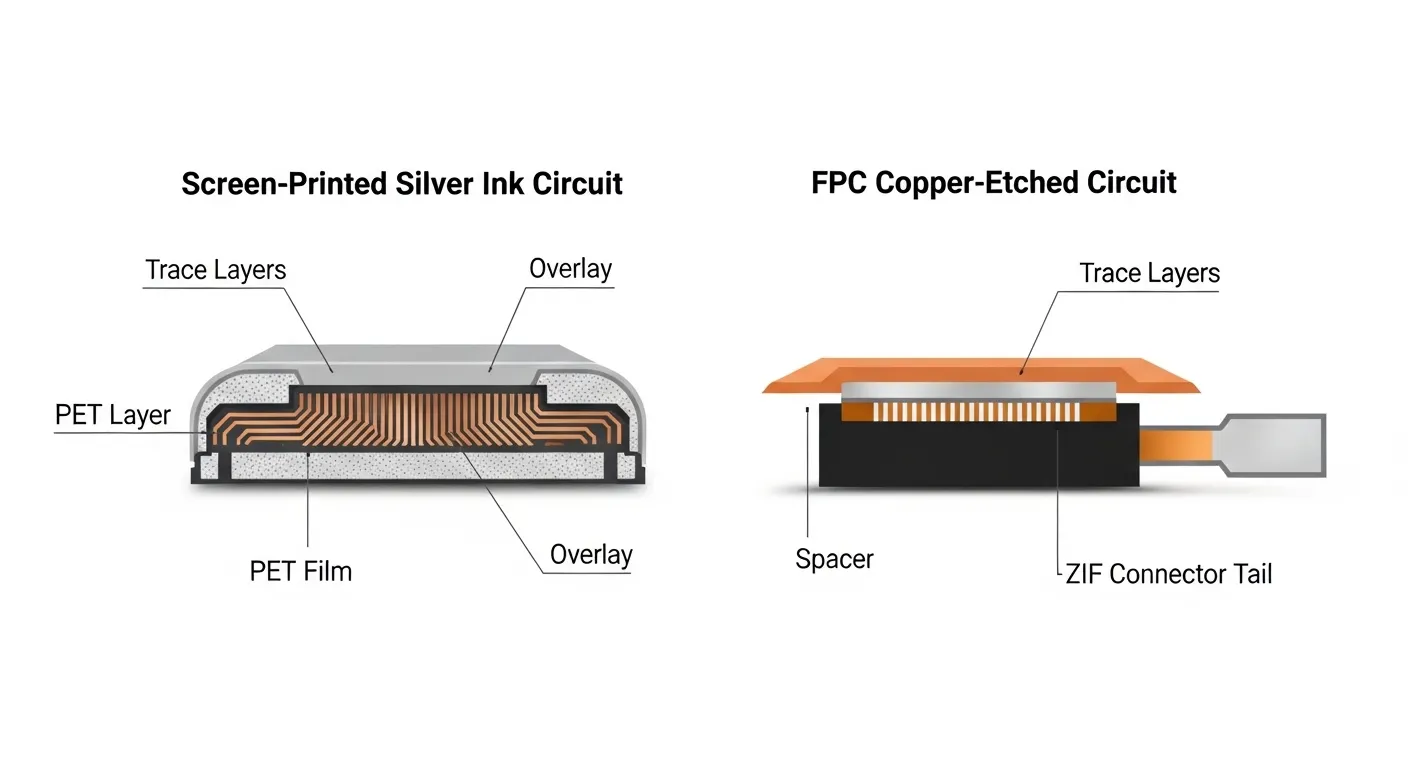
This is the most consequential decision at prototype stage, and it’s one most online prototype suppliers don’t explain clearly.
Screen-printed silver ink is lower cost, faster to produce, and suitable for most standard membrane switch designs. Use it for prototypes when your production design will also use silver ink — a straightforward HMI panel with simple trace routing, low cycle-life requirements, and no tight impedance specs.
FPC (copper-etched flexible printed circuit) is more expensive and takes longer at prototype stage, but gives you production-representative electrical performance. Use it when your production intent is FPC — especially for designs with tight trace spacing, high-current paths, ZIF connector integration, or demanding flex-cycling environments.
The critical rule: prototype with the same circuit substrate you plan to use in production. If you prototype with silver ink and switch to FPC for production, your electrical testing results from the prototype will not transfer — and you will need to re-test after the circuit change.
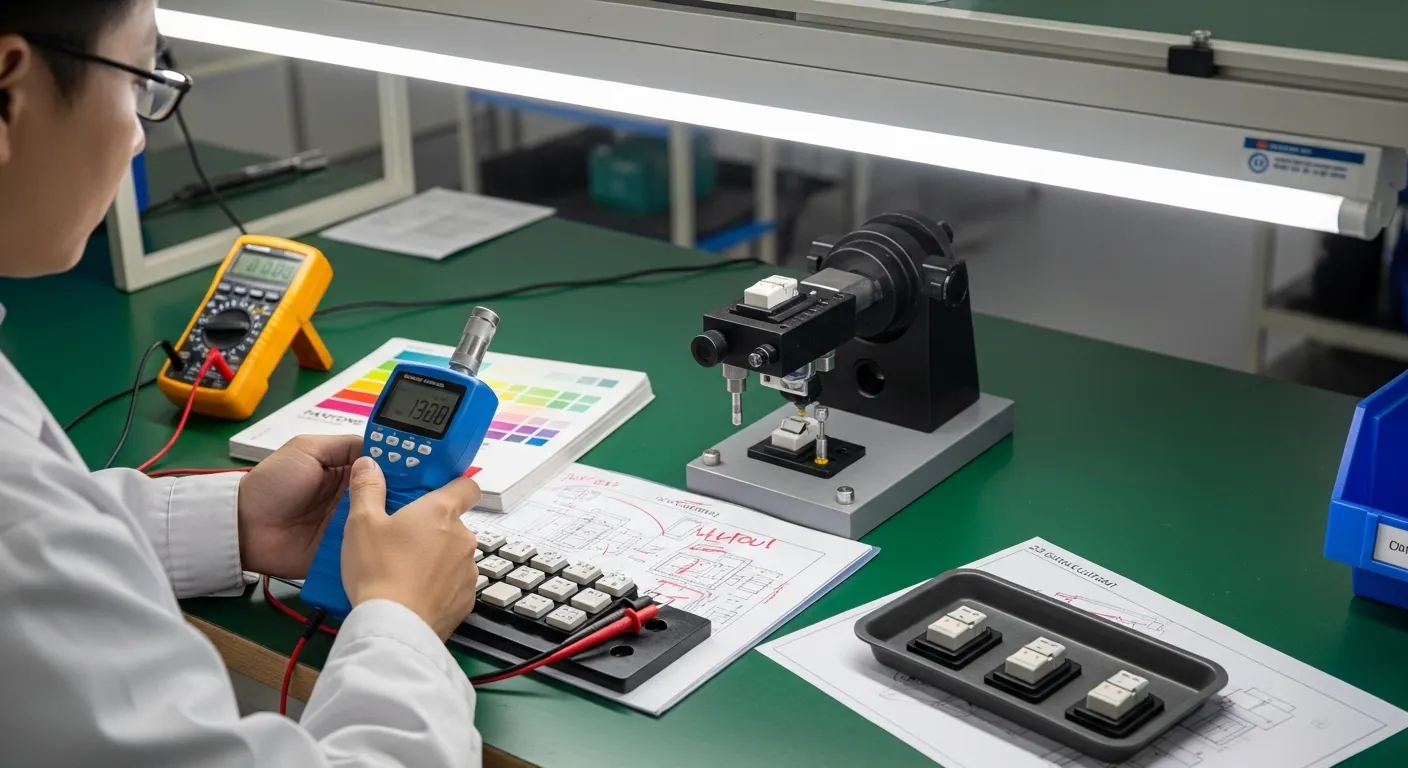
A prototype is only useful if you test it against your actual design requirements. Work through this checklist before signing off:
Document any out-of-spec results and mark up the physical sample or annotate a scan of the overlay. Send revision notes with the sample or via email to start the next iteration.
Once your prototype is approved, Niceone’s Dongguan production team picks up the same engineering files, material specs, and BOM used for the prototype. There is no supplier handoff, no re-qualification of materials, and no translation of specs between a prototype house and a production manufacturer.
Our CT office coordinates revision feedback and production scheduling during US business hours — so prototype sign-off and production release don’t require you to work around a time zone gap. If the approved prototype involved a circuit revision or material substitution, a final pre-production sample can be requested before the full production run begins.
Prototype runs at Niceone typically start at 5–10 units for functional samples, though quantity is specified per project based on your design complexity and testing requirements. Contact our team for minimum quantities on your specific configuration.
Yes. An overlay-only sample is a separate deliverable with a shorter lead time (typically 3–5 business days). It lets you verify colors, embossing, texture, and dimensional fit before the circuit assembly begins. Note that overlay-only samples cannot validate actuation force, circuit continuity, or IP sealing.
Yes, wherever possible. We specify the same overlay material, circuit substrate, adhesive system, and dome type for prototype and production. If a production-grade material substitution is required at prototype stage, our team will flag it in the quote.
Send your brand hex code, a physical color swatch, or a detailed color description. Our Dongguan print team references a current Pantone guide and will identify the closest PMS match for your review before printing begins.
Mark up the physical sample or annotate a design file and send it to our team with specific notes. Revision cycles generate a revised quote and new lead time, which varies by the scope of the change. Minor overlay revisions typically turn faster than circuit-level changes.
Submit your prototype inquiry to our engineering team with the following:
Our Dongguan factory handles prototype fabrication. Our Connecticut office — 18 Dayton Rd, Redding, CT 06896 — handles US-timezone communication, file review, and quote follow-up.
Do you have any questions, or would you like to speak directly with a representative?

