

Contact
Write to Us And We Would Be Happy to Advise You.
Do you have any questions, or would you like to speak directly with a representative?
By Fariha
Niceone-Keypad designs and manufactures custom PCB membrane switch assemblies for OEM engineers who need more than a simple flexible circuit. If your HMI requires dense routing, soldered SMD LEDs, resistors, connectors, display indicators, stable tactile dome mounting, or a larger rigid panel, a PCB-backed membrane switch may be the better build option to quote.
This page is for hardware design engineers, product engineers, and procurement teams comparing rigid PCB, FPC, and silver-flex circuit constructions for complex membrane keypads. The goal is not to make every project use PCB. The goal is to help you decide when PCB adds real value, when FPC is enough, and what details Niceone’s engineering team needs before preparing a custom RFQ.
Niceone supports membrane switches, graphic overlays, backlighting, tactile and non-tactile key designs, waterproof construction, FPC, and PCB-based builds through our Dongguan factory, with US-office support in Redding, Connecticut.
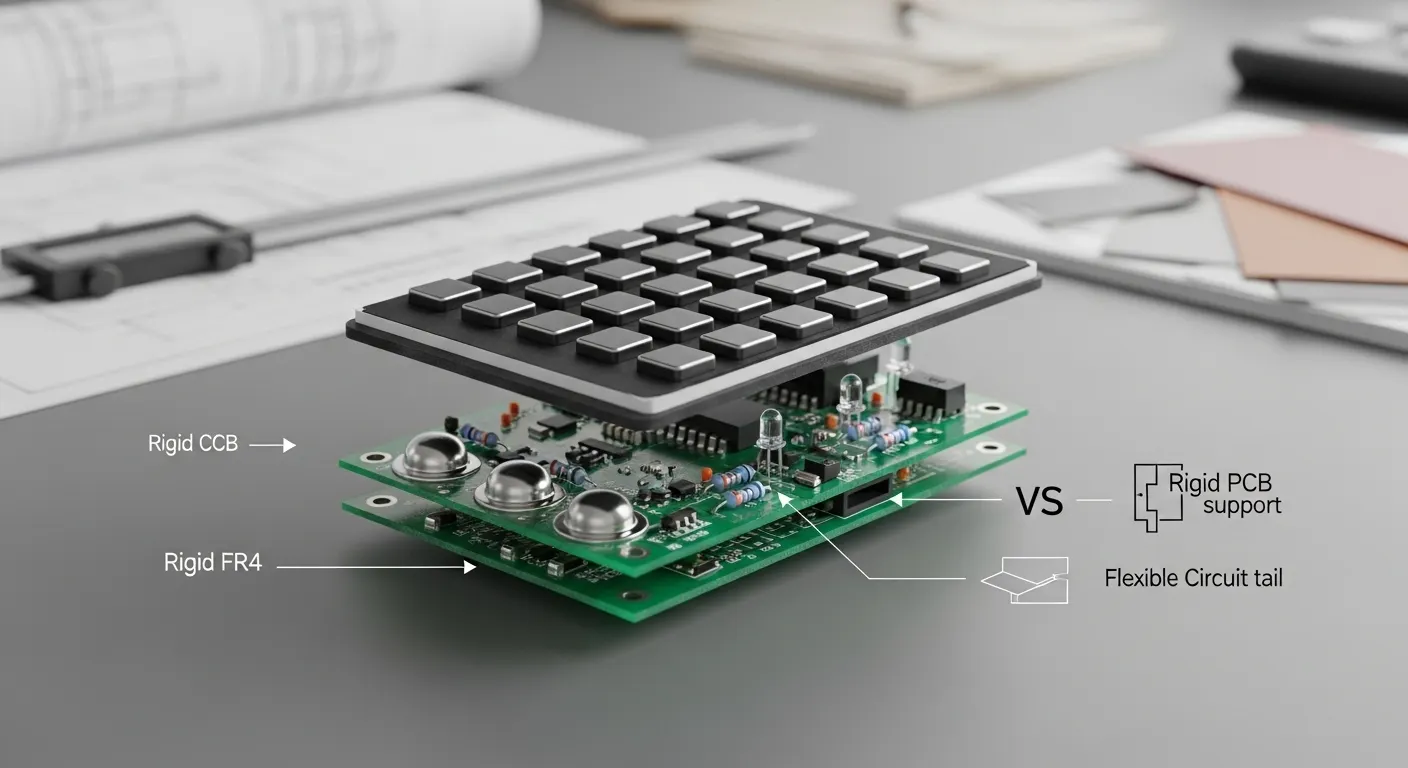
A PCB membrane switch is usually the better choice when the circuit layer must also act as a stable mechanical platform. FPC is excellent for thin, flexible, curved, or space-limited designs. But some HMI assemblies need more rigidity, stronger solder joints, or more complex routing than a film-only circuit can provide.
Choose PCB-backed construction when the design includes:
PCB is not automatically the premium answer for every keypad. If the HMI needs to bend around a housing, pass through a narrow slot, or stay extremely thin, FPC or silver-flex construction may still be the better option.
In a PCB-backed membrane switch, the printed circuit board sits below the graphic overlay, adhesive, spacer, and dome structure. The PCB replaces or supports the flexible circuit layer and can carry copper traces, plated holes, solder pads, mounted components, and connector hardware.
A typical build may include:
For projects where the overlay artwork, window clarity, embossing, and surface finish also matter, review Niceone’s graphic overlay manufacturing process.
The key difference is that the PCB is not only an electrical layer. It can also become a structural and assembly platform for the HMI.
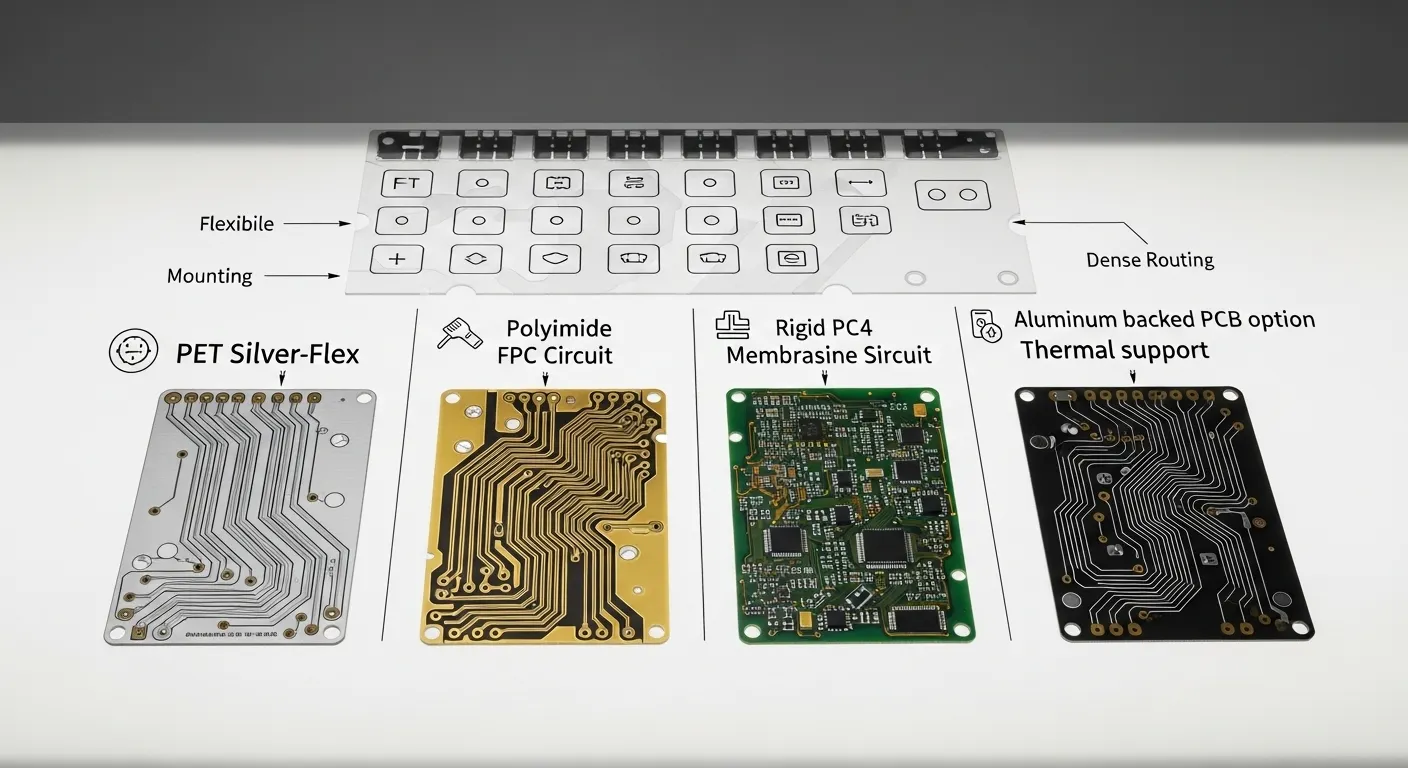
The right substrate depends on the enclosure, component needs, wiring route, tactile feel, and cost target. Many buyers search for PCB membrane switches because they already know the design is becoming too complex for a simple circuit.
| Design requirement | Silver-flex PET | FPC / polyimide copper circuit | Rigid PCB / FR4 | Aluminum-backed or metal-backed option | RFQ note |
|---|---|---|---|---|---|
| Simple key matrix | Good fit | Possible, but may be over-specified | Usually unnecessary | Usually unnecessary | Share key count and pinout |
| Thin flexible tail | Good fit | Strong fit | Needs connector or cable solution | Not typical | Confirm tail length and exit |
| Dense routing | Limited | Better | Strong fit | Strong fit if heat matters | Send schematic or circuit drawing |
| SMD LEDs / resistors | Limited | Possible | Strong fit | Strong fit for thermal review | Send BOM and LED data |
| Large rigid HMI panel | May need backer | May need backer | Strong fit | Strong fit | Send panel size and mounting details |
| High LED count | Depends on current and layout | Possible | Better support | Consider for heat spreading | Define current, voltage, duty cycle |
| Lower cost target | Often strongest | Mid-range | Higher assembly cost | Higher cost and review | Ask for value-engineering review |
This comparison helps avoid overbuilding. A rigid PCB can improve assembly and reliability in complex designs, but it can also add fabrication, SMT, inspection, and sourcing steps.
A major reason to choose PCB construction is component integration. Instead of using a separate PCB, harness, and membrane panel, the switch assembly may carry selected electronics directly on the board.
Depending on the project design, PCB-backed membrane switches may support:
This can simplify final equipment assembly. It can also reduce wiring complexity inside the device. However, it requires clearer engineering input at the RFQ stage. Niceone’s team needs to understand the circuit, component placement, connector orientation, and housing constraints before confirming the best build.
If the user interface should be touch-sensitive rather than tactile or dome-based, compare this build with capacitive switch options.
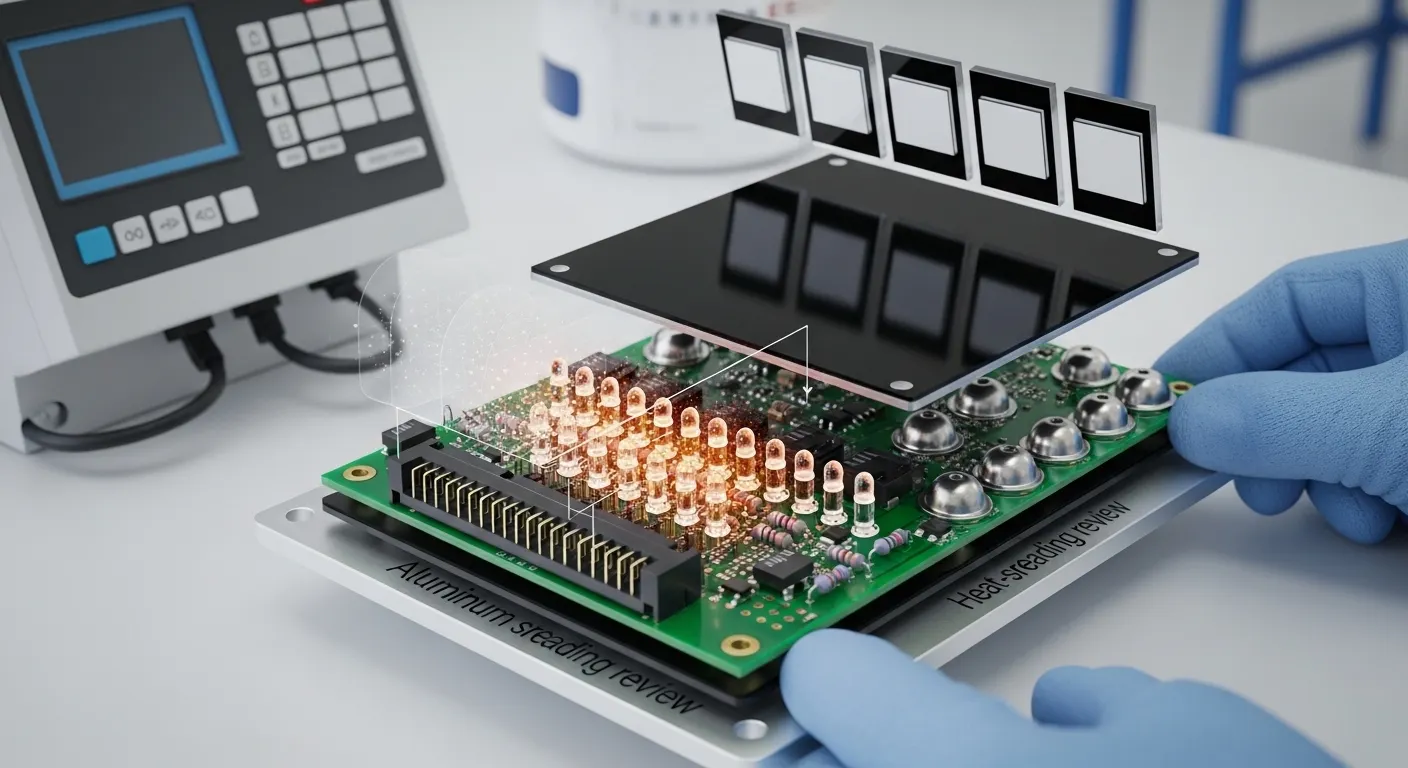
LED-heavy HMI panels need more careful planning than basic keypad circuits. A few low-current indicators may be simple. A large LED array, illuminated icons, or high-brightness status panel can affect current routing, component spacing, hot spots, and long-term stability.
PCB can help because copper routing and soldered components are more suitable for many LED layouts than printed silver traces. It also gives the assembly a rigid base for larger panels, display windows, and grouped indicator zones.
For some designs, an aluminum-backed PCB or metal-backed support may be worth discussing. This is not required for every backlit keypad. It becomes relevant when the design has higher thermal load, high LED density, continuous illumination, or a housing that limits heat dissipation.
Before quoting a high-LED PCB membrane switch, define:
PCB-backed membrane switches often cost more than simple PET silver-flex constructions. The reason is straightforward: the build may include PCB fabrication, soldering, SMT assembly, connector mounting, inspection, and more detailed DFM review.
That extra cost can be justified when the PCB replaces other parts of the final assembly. For example, a PCB membrane switch may reduce separate wiring, simplify connector placement, support more stable LED mounting, or combine tactile controls with indicator electronics.
The tradeoff should be reviewed early. If the only requirement is a simple low-profile key matrix, PCB may be unnecessary. If the design needs component integration, rigid support, or dense routing, PCB may reduce risk in the finished product.
A practical RFQ should compare the total assembly, not just the switch unit price.
A PCB membrane switch quote needs more detail than a basic overlay or simple keypad. The clearer the RFQ package, the faster the design review can focus on manufacturability, cost, and assembly risk.
Send Niceone these details when available:
If you are unsure whether the circuit should be PCB, FPC, or silver flex, send the functional requirements first. Niceone’s design studio can review the construction choice before the detailed quote.
PCB-backed membrane switches are useful when the HMI is more than a simple button panel. They fit equipment where the interface needs tactile control, indicator lighting, stable mounting, and clean integration into the enclosure.
Common project types include:
For designs where the front interface may perform better as a molded keypad, compare the feel, sealing, and assembly style with Niceone’s silicone rubber keypad options.
Not always. PCB is better for rigid support, soldered components, dense routing, and stable connectors. FPC is better when the circuit must bend, fold, or fit into a very thin curved space.
Yes, many PCB-backed builds can support SMD LEDs, resistors, diodes, and connectors. The exact layout depends on the circuit design, available space, heat load, and assembly method.
It can be designed for sealed or waterproof applications, but the target rating must be reviewed per project. Overlay, adhesive, spacer, connector exit, rear sealing, and housing interface all affect the result.
Consider it when the design has high LED density, continuous illumination, thermal concerns, or a need for stronger heat spreading. It should be reviewed with electrical load and mechanical mounting details.
Usually yes. PCB fabrication, soldering, SMT assembly, and inspection add cost. However, PCB may reduce wiring, separate boards, or final assembly steps in complex HMI designs.
Send panel drawings, overlay artwork, circuit schematic, component list, LED data, connector details, IP target, mounting surface, and expected quantity. If unsure, send the application requirements first.
If your HMI needs dense routing, SMD LEDs, integrated connectors, rigid support, or heat-aware backlighting, send your drawings to Niceone-Keypad for a PCB membrane switch review.
Include your panel layout, circuit schematic, LED and component list, connector position, overlay artwork, IP-rating target, housing details, and sample or production quantity. Our Dongguan factory team and CT office support can help confirm whether rigid PCB, FPC, silver-flex, or an aluminum-backed option is the right build for your custom membrane switch project.
Do you have any questions, or would you like to speak directly with a representative?

