

Contact
Write to Us And We Would Be Happy to Advise You.
Do you have any questions, or would you like to speak directly with a representative?
By Fariha
Niceone-Keypad helps compliance engineers, OEM hardware teams, and US-market procurement buyers specify custom membrane switches when a UL certified membrane switch requirement appears in a drawing, BOM, or end-product compliance file. In many projects, “UL” does not mean one simple thing. UL 969 often relates to the graphic overlay or permanent marking construction, while the finished membrane switch may involve separate electrical, flammability, or end-product requirements.
This page explains what UL 969 can prove, what it does not prove, and what buyers should confirm before requesting a quote. Niceone’s Dongguan factory and Redding, Connecticut office can support membrane switch, graphic overlay, FPC, PCB-based switch, tactile dome, backlighting, and sample discussions for UL-sensitive builds.
Before quoting, our team needs the real compliance requirement, the application surface, exposure conditions, material stack, and any UL or NRTL documentation your product team must follow.
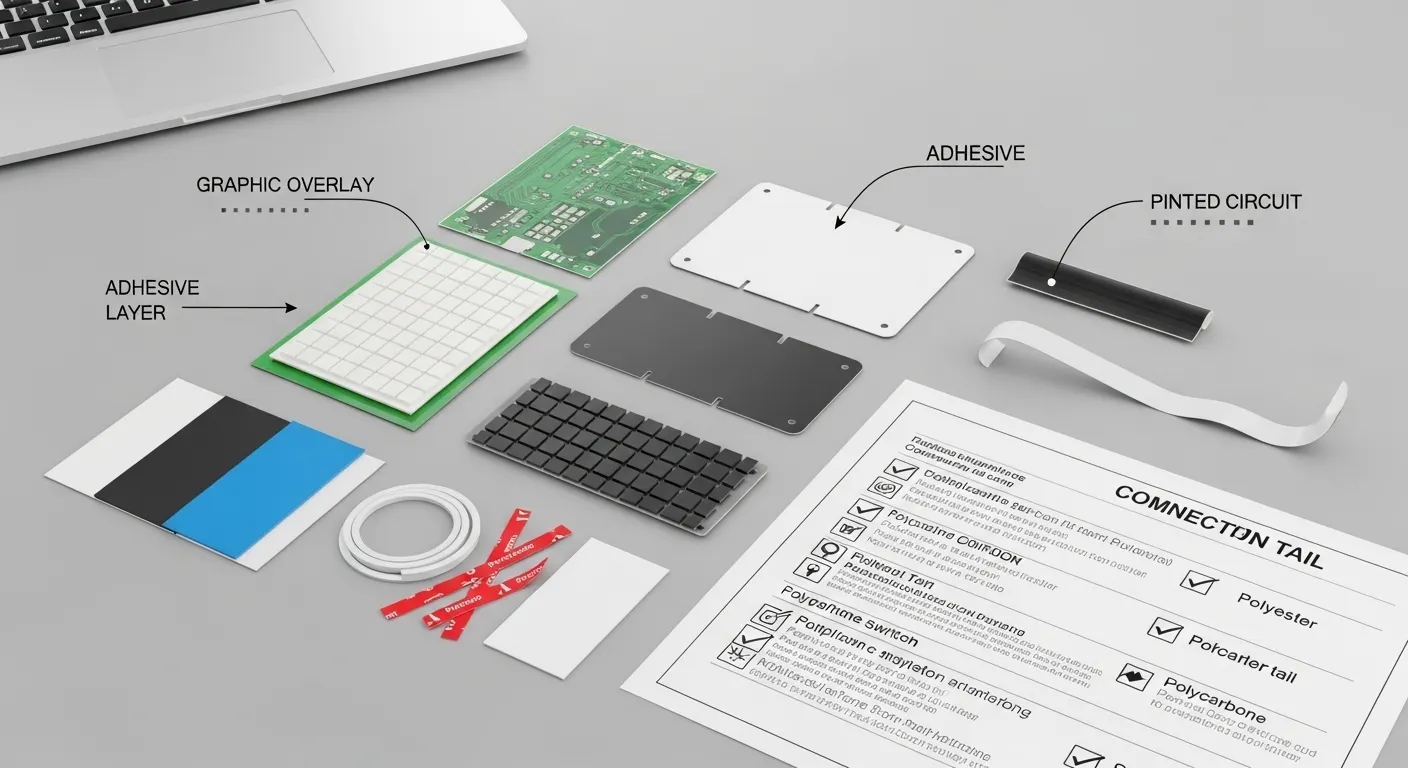
Not always. In many buyer conversations, “UL certified membrane switch” is shorthand for a membrane switch that uses a UL-recognized overlay, label, adhesive, or marking construction. That wording can create confusion during supplier selection.
A membrane switch is not only a printed front label. It may include:
UL 969 is most often connected with the overlay or permanent marking system. It does not automatically certify the complete switch circuit, electrical performance, IP sealing, or final HMI assembly.
For buyers, the safer first question is not “Is this membrane switch UL certified?” It is: Which part of the construction must meet which UL requirement?
UL 969 is commonly referenced for durable labels, markings, nameplates, and graphic overlays. In membrane switch projects, that usually means the front overlay or printed marking must remain legible and bonded under defined use conditions.
For a membrane switch overlay, UL 969-related evaluation may involve the full marking construction, not only the top film. The controlled system can include:
This matters because a small change can affect compliance. Switching adhesive, film, ink, laminate, or the surface the overlay bonds to may require review. A UL-sensitive overlay should be treated as a controlled construction, not a decorative sticker.
For Niceone, the buyer’s overlay drawing, artwork, material preference, surface details, and compliance notes help our engineering team review the correct build path before sampling.
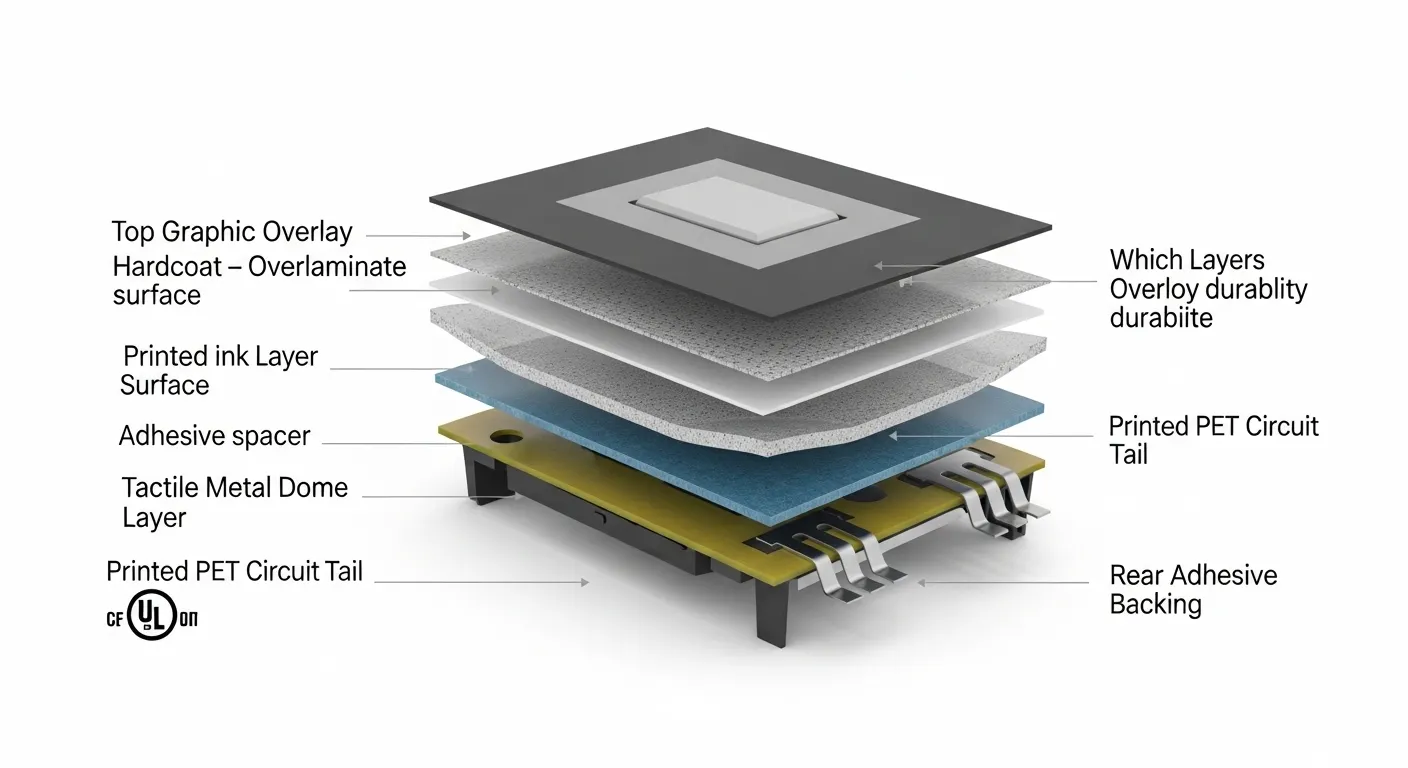
UL 969 is not a full electrical safety approval for a membrane switch circuit. It does not automatically prove the switch has a specific current rating, dielectric performance, flammability rating, IP rating, or cycle-life result.
That distinction is important for equipment used in industrial controls, medical devices, home appliances, instrumentation, marine electronics, HVAC panels, or food-processing equipment. Your end product may need a compliant marking, a durable overlay, and a separate review of the switch function.
A UL 969-related overlay does not normally answer questions such as:
These questions belong in the full membrane switch specification. They should be reviewed before prototype approval.
| Buyer question | Relevant area | What may be covered | What is not automatically covered | What to send in the RFQ |
|---|---|---|---|---|
| Will the front marking stay readable? | UL 969 overlay / marking system | Legibility, adhesion, environmental durability under defined conditions | Switch circuit or electrical rating | Overlay artwork, material, exposure, application surface |
| Is the complete switch electrically evaluated? | Membrane switch / end-product requirement | May require separate switch or equipment review | Not proven by UL 969 alone | End-product UL notes, circuit spec, voltage/current details |
| Can we change adhesive or overlay film? | Controlled label construction | Only if the change still fits the approved construction path | Substitutions may affect compliance | Existing material callout, proposed replacement, surface type |
| Does the panel meet an IP rating? | Sealing design and validation | Project-specific gasket, adhesive, edge seal, enclosure fit | Not guaranteed by UL 969 | IP target, enclosure drawing, mounting method |
| Are chemicals or cleaners acceptable? | Overlay durability requirement | Depends on tested exposure and material stack | Not universal for all solvents | Cleaner list, wipe frequency, environment |
If the requirement concerns the membrane switch as a human-actuated electrical component, UL 969 may not be the main reference. UL 2557 or the end-product UL standard may be more relevant, depending on the product and how the switch is used.
For example, an appliance control panel, industrial machine interface, power equipment keypad, or medical device front panel may have a larger compliance file. The membrane switch may need to fit that file’s material, marking, spacing, flammability, and documentation requirements.
In those cases, the buyer should provide:
Niceone can review the project requirements and help align the membrane switch construction with the buyer’s documented needs. However, the compliance owner or NRTL engineer should confirm the final approval path.
A UL-sensitive membrane switch overlay should not be treated as a flexible cosmetic layer. The material stack affects durability, adhesion, appearance, and documentation.
Key details to control include:
If your purchasing team changes a material after approval, the compliance discussion may need to restart. For that reason, confirm the stack-up before ordering production samples.
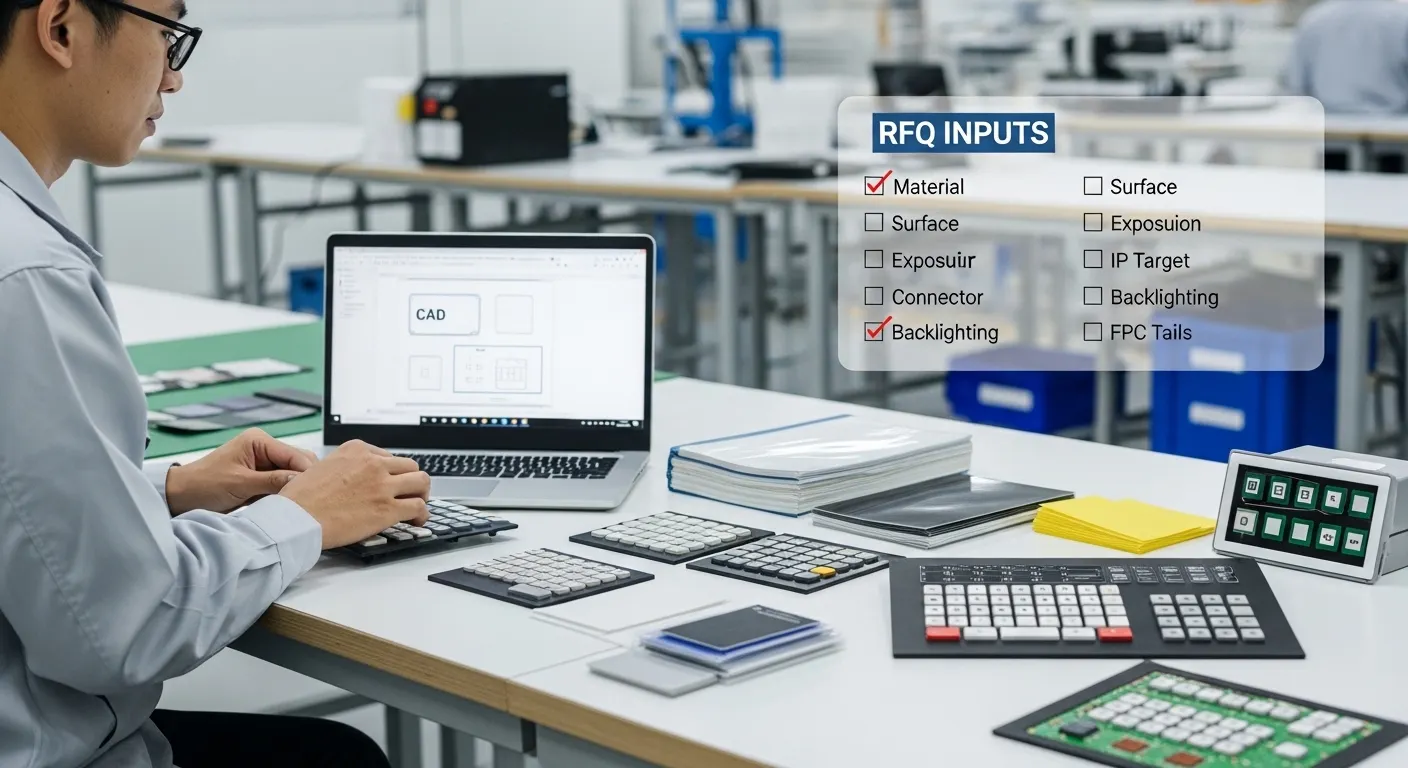
For a UL-related RFQ, send more than a panel size and color file. The more complete the compliance context, the faster the engineering review.
Please include:
For sample planning, you can also review Niceone’s membrane switch sample workflow.
Niceone-Keypad manufactures custom membrane switches and HMI components through its Dongguan factory and supports US buyers through its Connecticut office. This structure helps buyers who need factory-level customization with clearer communication for US-market projects.
For UL-sensitive builds, Niceone can help review:
Niceone should not be selected only because a page says “UL.” The better approach is to match the construction to the real requirement, document the chosen stack, and confirm what your compliance team needs before approving samples.
For supplier background, see Niceone’s Dongguan manufacturing overview.
Before moving from sample to production, confirm the parts of the build that affect compliance and performance.
Check these items:
This step reduces late-stage changes. It also helps procurement, engineering, and compliance teams approve the same version of the product.
No. UL 969 usually relates to the overlay or marking construction. The complete membrane switch may need separate review for circuit, safety, sealing, or end-product requirements.
No. UL 969 is mainly about marking durability, adhesion, and legibility under defined conditions. It does not automatically prove electrical rating or switch safety.
Ask about UL 2557 when the membrane switch itself is being reviewed as a switch component, not only as a printed overlay or label.
Do not assume so. Adhesive, film, ink, laminate, and application surface may be part of a controlled construction. Confirm changes before production.
List real cleaners and exposures, such as IPA, detergent, disinfectant, oil, solvent splash, humidity, water, abrasion, and outdoor UV exposure.
Send drawings, artwork, UL notes, application surface, exposure conditions, IP target, circuit type, connector details, backlighting needs, and sample quantity.
If your drawing or compliance file calls for a UL certified membrane switch, UL 969 overlay, or UL-sensitive HMI panel, send the requirement to Niceone-Keypad before finalizing the build. Include your drawings, overlay artwork, UL or NRTL notes, application surface, cleaning chemicals, IP target, circuit type, connector details, backlighting requirement, and sample needs.
Niceone’s engineering team can review the stack-up, prepare a custom membrane switch direction, and support your RFQ discussion through our Dongguan factory and Connecticut office.
Do you have any questions, or would you like to speak directly with a representative?

