

Contact
Write to Us And We Would Be Happy to Advise You.
Do you have any questions, or would you like to speak directly with a representative?
By Fariha
Niceone-Keypad builds custom RoHS compliant membrane switch assemblies for OEM engineers, procurement teams, and compliance buyers who need material-controlled HMI parts for EU-market electronic equipment. If your project requires RoHS review, our team can help you specify the membrane switch stack, check the compliance-sensitive materials, and align the RFQ with the documentation your internal quality team expects.
For a membrane switch, RoHS compliance is not confirmed by the graphic overlay alone. The review should include the overlay film, adhesives, printed inks, conductive silver or carbon traces, FPC or PCB layers, connector, metal dome, LED backlighting, gasket, coating, and any bonded or soldered components.
This page explains which build choices affect RoHS compliance, what documents buyers should request, and what to send Niceone before quotation or sample production. For broader factory background, see Niceone’s Dongguan membrane switch manufacturing page.
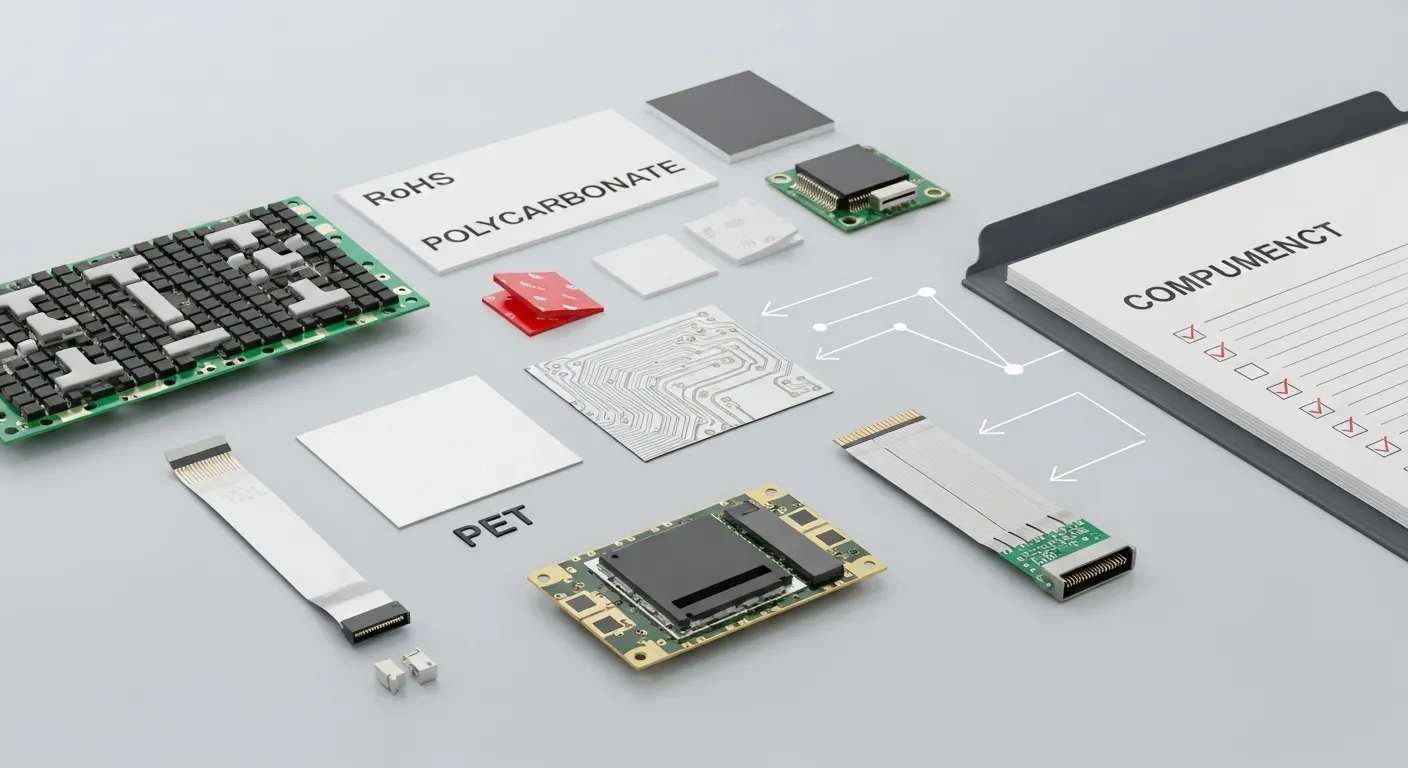
RoHS limits hazardous substances in electrical and electronic equipment. For a membrane switch, the key point is simple: every relevant material in the assembly should be reviewed, not just the visible keypad surface.
A custom membrane keypad may include several material groups:
For compliance engineers, the important question is not only “Is the supplier RoHS compliant?” It is “Which materials are used in this exact build, and what evidence supports them?”
RoHS currently focuses on 10 restricted substances. A buyer does not need to test every part blindly, but the material stack should be selected and documented with these substances in mind.
The 10 substances are:
In membrane switch production, these concerns usually connect to pigments, inks, adhesives, flame-retardant plastics, metal plating, connector housings, soldered components, PCB finishes, and some flexible circuit materials.
For example, a simple PET overlay with printed silver circuitry may have a different documentation path from a PCB-backed membrane switch with LEDs, resistors, soldering, connectors, and plastic housings. The more components added to the assembly, the more important the material declaration package becomes.
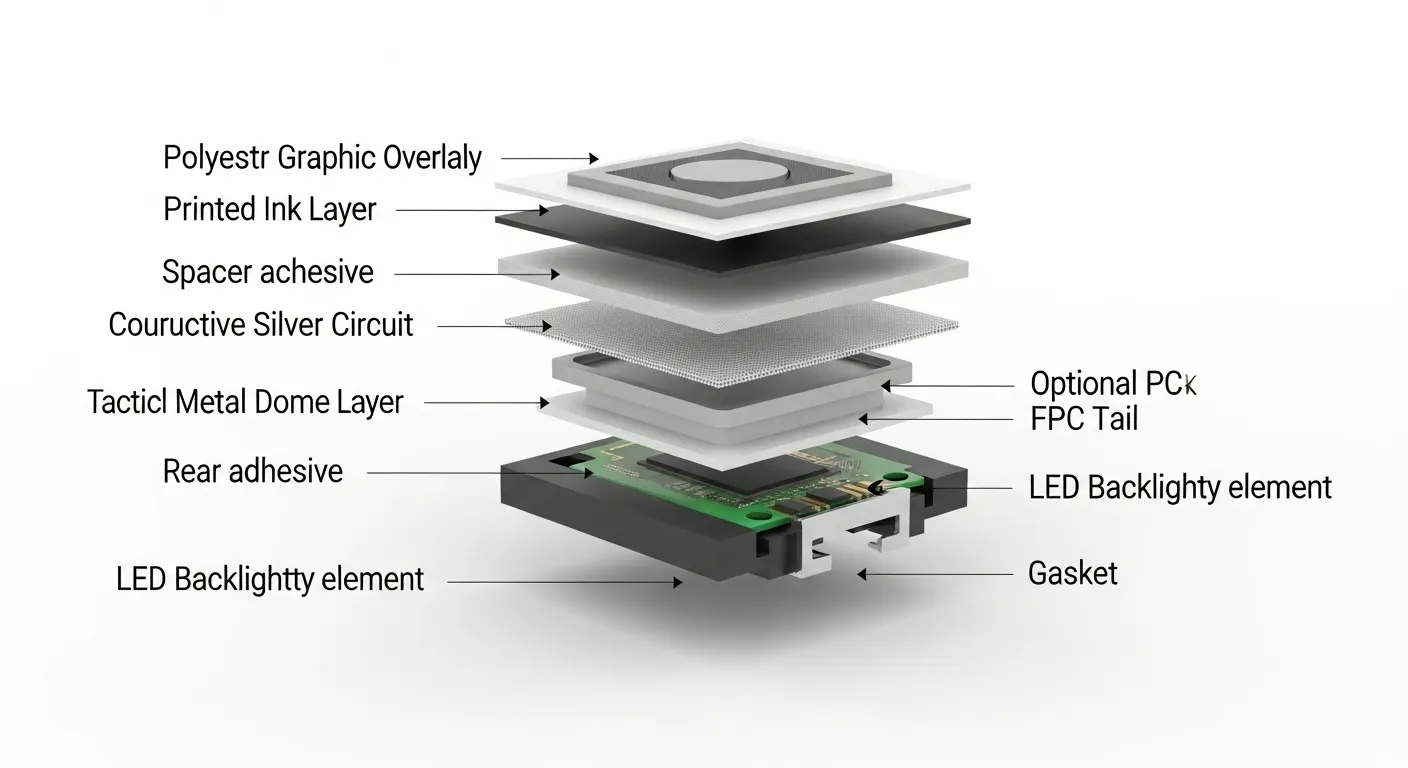
RoHS review should follow the real construction of the part. A membrane switch is a layered assembly, so each layer should be specified clearly before production.
| Membrane switch layer / component | RoHS concern to check | Build choices that affect compliance | Documentation to request | RFQ note for Niceone |
|---|---|---|---|---|
| Graphic overlay | Film, coating, pigment, printed graphics | PET, PC, hard coat, matte/gloss finish, printed colors | Material declaration or supplier statement | Send overlay material preference and color requirements |
| Adhesive layers | Plasticizers or restricted substances in adhesive system | Spacer adhesive, rear adhesive, gasket adhesive, 3M-type PSA | Adhesive data or compliance statement | Specify mounting surface and adhesive grade if required |
| Printed circuit | Conductive ink composition | Silver ink, carbon ink, printed PET circuit | Ink/material declaration or test report if required | Confirm silver ink circuit or alternative circuit type |
| FPC layer | Flexible substrate, copper, coverlay, stiffener | FPC tail, FPC circuit, reinforcement area | FPC material declaration | Send tail length, pin pitch, and connector interface |
| PCB-backed layer | Solder mask, surface finish, soldered parts | PCB, LEDs, resistors, connector, soldering | PCB/component RoHS records | Confirm if the switch needs PCB integration |
| Tactile dome | Metal finish or plating | Stainless dome, nickel-plated dome, dome retainer | Dome supplier declaration | Send tactile force or click feel target |
| Backlighting | LEDs, light guide film, fiber optic, EL components | LED color, light guide film, diffuser, resistors | Component declarations | Specify brightness, color, and power input |
| Connector / tail | Plastic housing, pins, plating | ZIF, female connector, pin header, custom pitch | Connector supplier declaration | Send connector drawing or mating part details |
This matrix helps buyers prepare a more accurate RFQ. It also reduces back-and-forth during compliance review.
Adhesives, inks, conductive traces, and flexible circuits often receive extra attention because they are not always visible in the finished membrane panel. They can still affect the compliance status of the assembly.
For adhesive selection, do not rely only on a brand name. Buyers should confirm the exact adhesive grade, mounting surface, temperature exposure, cleaning exposure, and documentation requirement. A rear adhesive for a powder-coated metal enclosure may not be the same choice as an adhesive for glass, ABS plastic, or a curved appliance surface.
Printed inks also need review. Graphic inks may include pigments and binders, while conductive silver ink forms the electrical trace layer. If the buyer needs a RoHS documentation pack, the ink system should be part of the material review.
FPC and PCB-based membrane switches add more components to the compliance scope. An FPC tail may include substrate, copper, coverlay, adhesive, stiffener, and plating. A PCB-backed membrane switch may also include solder mask, surface finish, LEDs, resistors, connectors, and soldered components.
This is why the safest RFQ language is project-specific. Instead of asking for “a RoHS membrane switch,” buyers should specify the full build and documentation expectation.
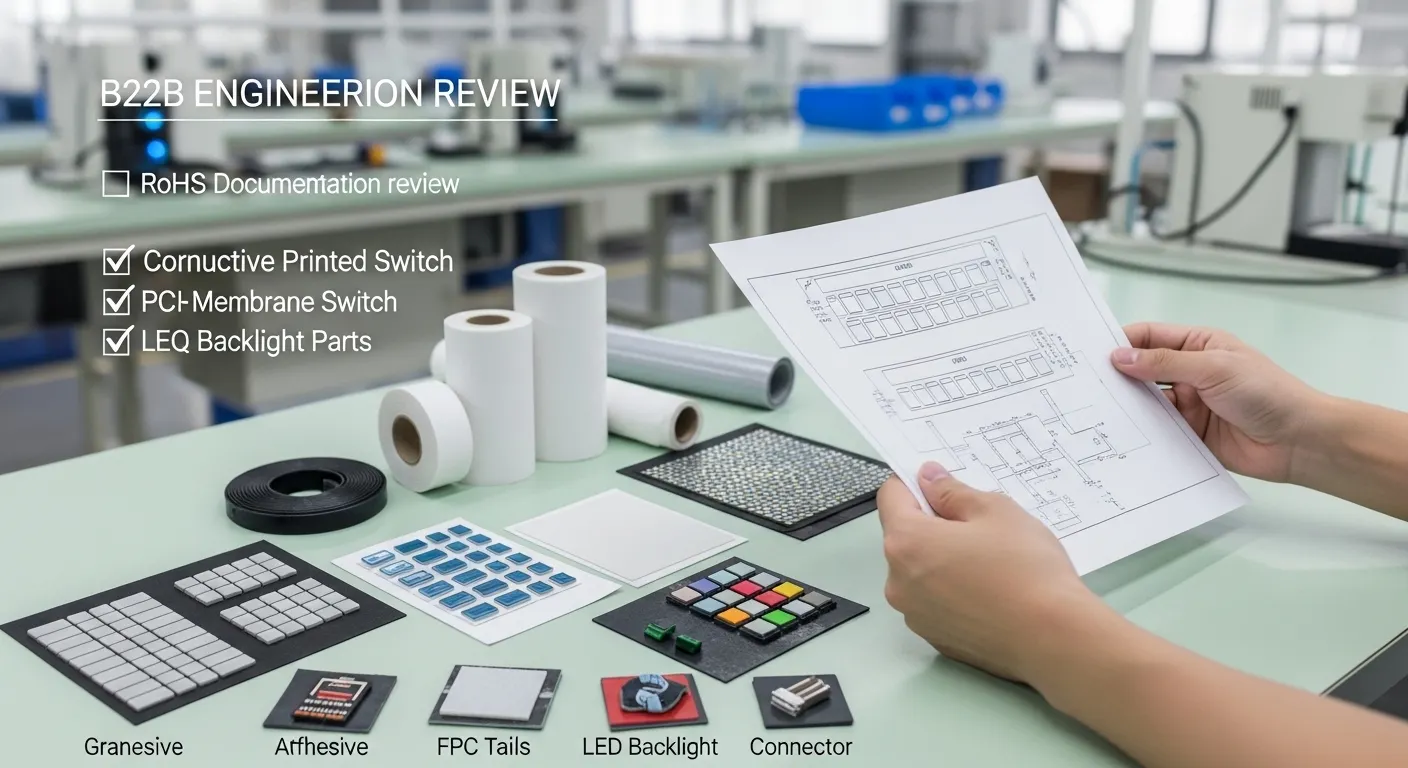
For EU-market equipment, the documentation package should match the buyer’s internal compliance process. Niceone can review the requested package during quotation so the material choices and records are aligned before sampling or production.
A RoHS documentation request may include:
Buyers should confirm document expectations early. If the compliance team needs a specific declaration format, test method, supplier form, or restricted substance list, include it with the RFQ instead of waiting until production approval.
For prototype or sample planning, see Niceone’s membrane switch sample request process.
RoHS is a restricted-substance requirement. It does not replace safety review, environmental testing, chemical registration obligations, or ingress protection testing.
Here is the practical difference:
A waterproof membrane switch can still need RoHS review. A RoHS compliant membrane keypad can still need UL-related material discussion if the buyer’s equipment requires it. For safety-focused sourcing, see Niceone’s UL membrane switch guide.
A strong RoHS-ready RFQ should make both the mechanical build and documentation needs clear. This helps Niceone recommend suitable materials and avoid redesign after compliance review.
Send the following when possible:
If your project is still early, Niceone’s design studio can review the application, layer stack, artwork, connector plan, and compliance notes before you finalize the drawing.
No. PET film may be a low-risk material choice, but the full assembly still matters. Adhesives, inks, silver traces, connectors, LEDs, FPC, PCB layers, coatings, and domes should also be reviewed.
Yes, if your compliance process requires material-level evidence. Conductive silver ink is part of the electrical circuit layer, so buyers may request supplier declarations or relevant test data for the ink system.
The exact adhesive grade should be checked. Do not treat a brand name alone as proof. Send the mounting surface, temperature exposure, and documentation requirement so the correct adhesive can be reviewed.
Usually, yes. FPC and PCB builds add materials such as copper, coverlay, solder mask, surface finish, stiffener, connector parts, LEDs, and soldered components. These may need separate documentation.
Ask for a project-specific declaration or CoC, material declarations, test reports where required, and a material stack summary. If your company has a supplier form, send it before quotation.
No. RoHS covers restricted substances. UL relates to safety requirements, while IP67 relates to dust and water ingress protection. A project may require more than one type of evidence.
Send Niceone-Keypad your drawing, target market, RoHS or RoHS + REACH requirement, overlay material, adhesive needs, circuit type, FPC or PCB details, connector pinout, backlighting plan, IP rating target, and required documentation format.
Our Dongguan production team and CT office can help review the build, confirm the compliance-sensitive materials, and prepare a quotation or sample plan for your RoHS compliant membrane switch project.
Do you have any questions, or would you like to speak directly with a representative?

