

Contact
Write to Us And We Would Be Happy to Advise You.
Do you have any questions, or would you like to speak directly with a representative?
By Fariha
HVAC OEM engineers specifying user-facing controls — thermostats, damper actuator panels, and rooftop unit HMIs — need a membrane keypad that survives the full service life of the equipment it controls. Niceone-Keypad designs and manufactures custom HVAC control membrane keypads from our Dongguan production facility, with design and procurement support through our US office in Redding, Connecticut. Whether you are specifying an indoor thermostat panel on a 24VAC low-voltage circuit or an outdoor rooftop unit HMI exposed to temperature extremes and UV cycling, the switch topology, overlay material, IP sealing, and backlighting method all need to be matched to the deployment environment before the design is finalized.
This page helps you identify the right specifications for your HVAC sub-application and prepare an accurate RFQ.
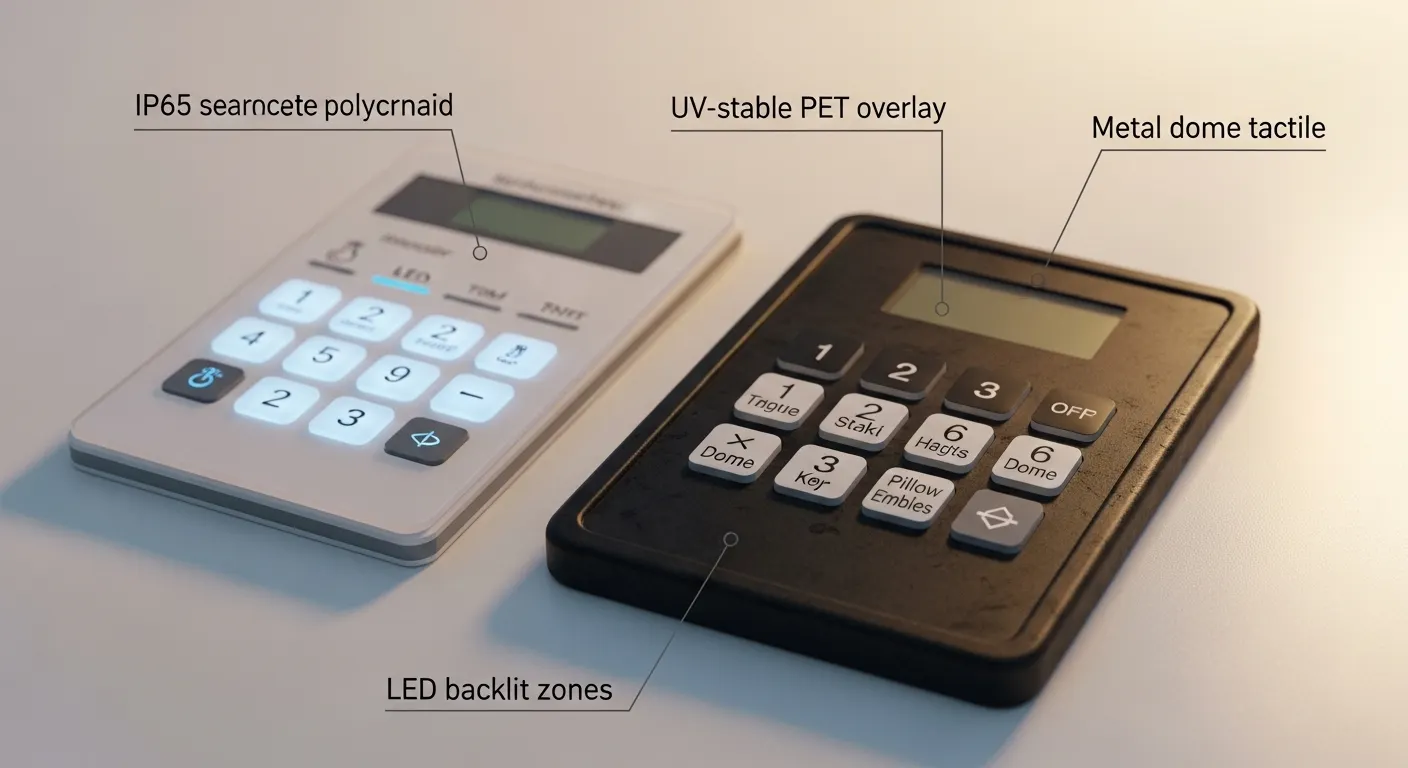
The requirements a membrane keypad must meet differ significantly across HVAC product types. An indoor thermostat panel operates in a mild, stable environment with low actuation frequency and a 24VAC power supply that limits the backlighting budget. A packaged rooftop unit HMI faces an entirely different load: thermal shock cycling between -40°C and 85°C, UV degradation on the graphic overlay, potential water ingress from rain or condensation, and gloved-hand operation by service technicians.
The common thread across all HVAC sub-applications is service life. HVAC equipment carries a 7–10 year expected product life. The control interface must match that commitment. For a thermostat used in a light commercial building — roughly 5–10 button presses per day over a 10-year service life — actuation cycles are not the primary stress. Thermal cycling, UV exposure, and adhesive delamination are far more likely failure modes for HVAC membrane panels than mechanical wear-out.
Match your product type to the baseline design requirements below before writing your RFQ.
| HVAC Sub-Application | Typical IP Rating | Operating Temp Range | Recommended Switch Type | Backlighting Option | Overlay Material |
|---|---|---|---|---|---|
| Thermostat (indoor wall panel) | IP54 | 0°C to 50°C | Capacitive or non-tactile membrane | LED / Light Guide Film (LGF) | Polycarbonate (PC) |
| Damper Actuator Controller | IP65 | -20°C to 60°C | Metal dome tactile | LED backlit | Polyester (PET) |
| Rooftop Unit (RTU) HMI | IP65 / IP67 | -40°C to 85°C | Metal dome tactile | High-brightness LED | UV-stable Polyester (PET) |
| Fan Coil Unit Controller | IP54 | 0°C to 55°C | Non-tactile or capacitive | EL or LED | Polycarbonate or Polyester |
IP ratings and temperature ranges reflect industry-standard design requirements for each application type. Niceone confirms specific tested capabilities during the design review stage.
Use this matrix as a starting spec anchor — not a final design spec. Your deployment conditions, housing design, and operator environment may shift one or more of these recommendations.
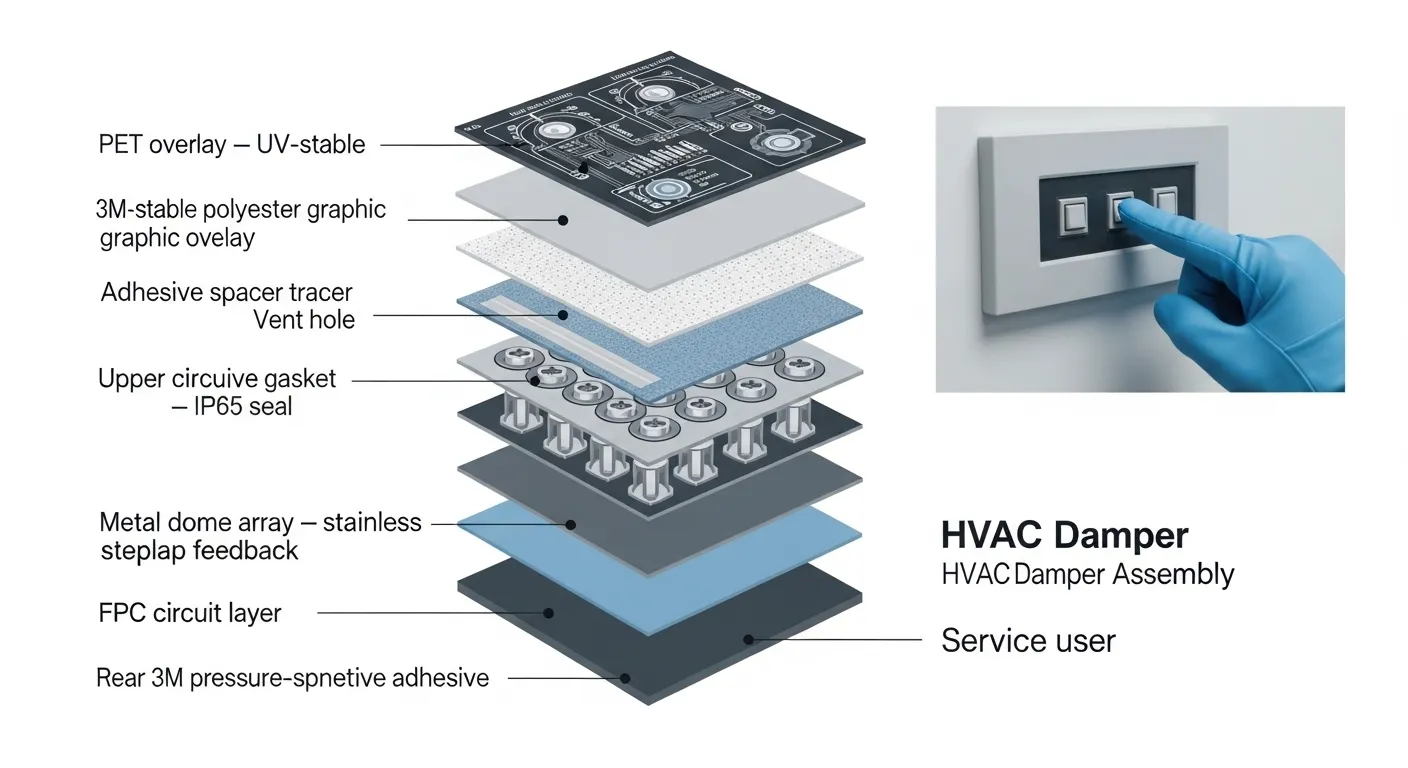
The choice between capacitive and tactile metal dome is the most consequential interface decision for HVAC control design. Each has a legitimate place in the HVAC product family — but not interchangeably.
Capacitive membrane switches are well-suited to indoor thermostat panels. With no moving parts, there is no mechanical wear path and no seal-breaking layer transition. Current draw is ultra-low, which matters on a 24VAC thermostat supply where the power budget for the control panel is constrained. Capacitive surfaces also maintain a clean graphic overlay with no embossed key zones, which supports the aesthetic requirements of commercial and residential thermostat designs.
The limitation is glove compatibility. Capacitive sensing with thick HVAC service gloves requires sensitivity tuning or a haptic feedback integration. For a thermostat adjusted by end users with bare hands, this is not a concern. For a panel that service technicians interact with on a rooftop — where gloves are standard — metal dome tactile is the better specification.
Metal dome tactile switches provide audible and physical confirmation of actuation, which is essential when a technician is working in ambient noise conditions or wearing PPE. The snap ratio of a correctly specified metal dome gives positive feedback even through gloved hands. For damper actuator controllers and RTU panels, metal dome is the default-correct choice. See Niceone’s metal dome membrane switch options for dome force and geometry configurations.
The circuit layer for both switch types can be built on a flexible printed circuit (FPC), which supports tighter tolerances and more reliable silver trace performance than screen-printed silver ink circuits — a relevant advantage for HVAC panels that see temperature-induced flex cycling. More on FPC construction at Niceone’s flexible printed circuit keypad page.
Rooftop unit panels are serviced at any hour. Fan coil units in mechanical rooms operate in near-darkness. Even commercial thermostats benefit from backlit displays and keypad zones for overnight adjustment without overhead lights.
LED backlighting is the most power-efficient option for HVAC membrane panels and draws 20–50 mA in typical configurations — comfortably within the available budget on most HVAC control circuits. For large thermostat overlays requiring even illumination across the full panel face, light guide film (LGF) distributes LED light uniformly without hot spots. Niceone has produced LGF membrane keypad panels to production volume.
EL (electroluminescent) backlighting produces very even, low-profile illumination and is suitable for thin-stack thermostat panels. It requires an AC inverter, which adds circuit complexity — a tradeoff to weigh against the lower EL panel brightness at typical 24VAC supply levels.
For RTU panels requiring high visibility at night or in direct sunlight glare, high-brightness LED backlighting with individual key zone control is the preferred specification. Backlight zones can be specified independently so non-active panel zones draw no current.
The graphic overlay is the membrane switch layer most directly exposed to the HVAC deployment environment. Material selection affects UV resistance, chemical resistance, surface hardness, and the ability to maintain IP-rated sealing over a 10-year product life.
Polycarbonate (PC) is dimensionally stable and takes digital printing with excellent color fidelity. It is the standard choice for indoor thermostat and fan coil unit overlays where UV exposure is not a factor. PC overlays can be produced with hardcoat finishes for scratch and abrasion resistance.
Polyester (PET) outperforms polycarbonate in chemical resistance, UV cycling, and thermal flex tolerance — making it the correct specification for damper actuator panels and RTU HMIs. For rooftop installations, UV-stable inks on PET substrate are required to prevent color shift and surface degradation within the product’s service window.
Sealing between the overlay and the housing is achieved through pressure-sensitive adhesive — typically a 3M-grade adhesive matched to the surface energy of the housing material and the IP sealing requirement. The adhesive spec must be reviewed against the thermal cycle range of the deployment environment to prevent delamination at temperature extremes.
For custom-printed graphic overlays and dome label integration, see Niceone’s dome label custom printing page.
Mechanical wear-out is rarely the lifecycle-limiting factor for HVAC membrane keypads. A commercial thermostat pressed 10 times daily for 10 years accumulates approximately 36,500 actuations — well within the operational range of a correctly specified membrane switch. Damper controller and RTU panels used primarily during commissioning and periodic service calls accumulate even fewer actuations.
The actual lifecycle risks for HVAC membrane keypads are material-based: UV-induced surface degradation on outdoor overlays, adhesive delamination under thermal cycling stress, and silver ink trace cracking under repeated substrate flex at low temperatures. Specifying polyester overlay with UV-stable inks, a thermally matched adhesive, and an FPC circuit layer for the outdoor sub-applications addresses all three failure modes before production.
For reference, Niceone has produced LGF membrane keypad panels rated to 1 million stroke cycles. For HVAC applications, the material and sealing specification matters more than the cycle count figure.
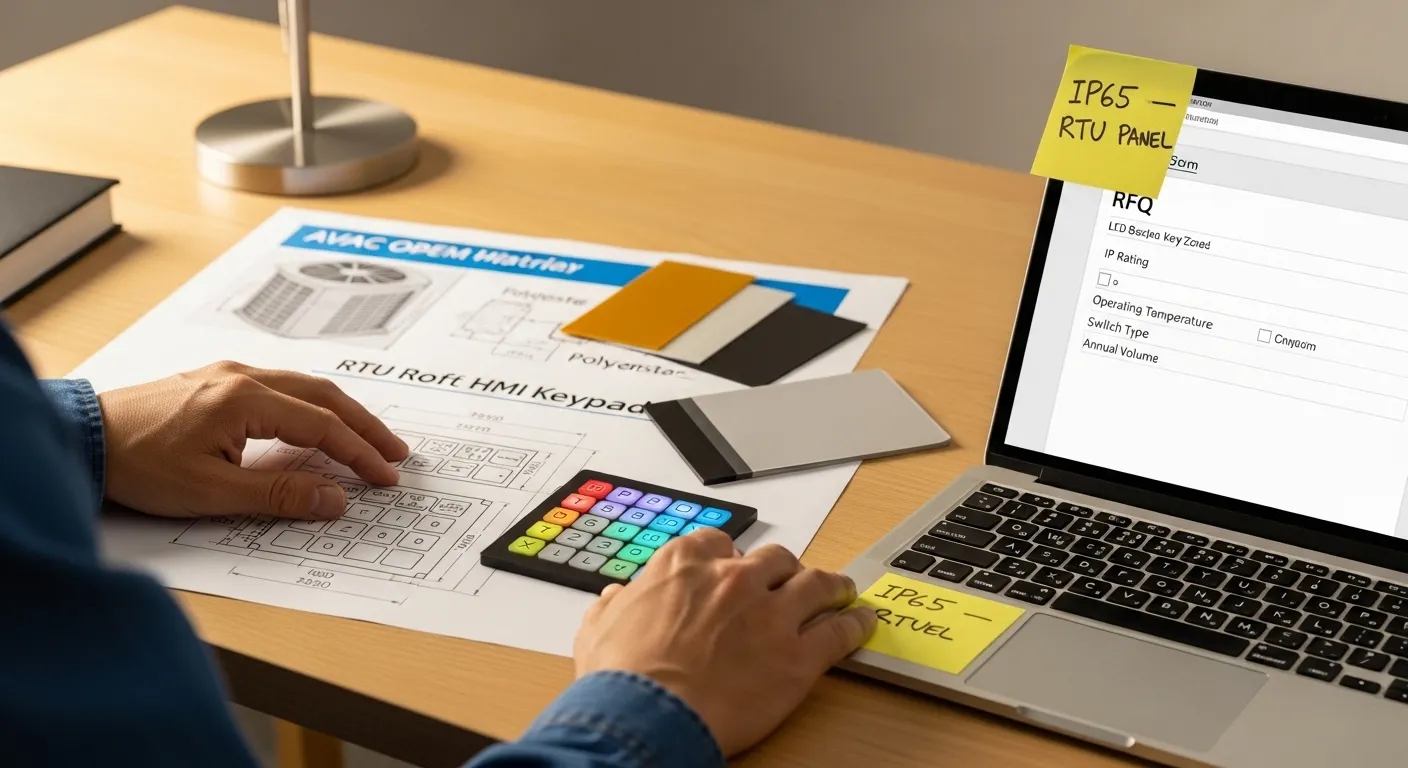
The faster you give our engineering team complete information, the faster we return an accurate quote. For HVAC HMI panels, include:
If your design is still early-stage, our Connecticut office can support a design consultation before a formal RFQ. Concept drawings and a description of the deployment environment are enough to begin.
IP65 is the baseline for most RTU applications — dust-tight and protected against directed water jets. IP67 applies where the panel may be temporarily submerged or subjected to high-pressure wash-down. Indoor thermostat panels typically require IP54. IP sealing is achieved through the adhesive gasket layer of the membrane switch assembly, not the switch type alone.
Yes, with the correct material specification. Polyester (PET) substrates and thermally matched 3M-grade adhesives handle thermal cycling down to -40°C for rooftop applications. Polycarbonate is suitable for indoor HVAC environments. Adhesive selection must be matched to the deployment temperature range to prevent delamination over the product’s service life.
Capacitive suits indoor thermostat panels — no mechanical wear, intact IP seal, low power draw for 24VAC circuits, clean aesthetic. Metal dome tactile suits RTU and damper panels where gloved-hand operation is standard and positive actuation confirmation is required. The right answer depends on who operates the panel and where.
Yes. LED backlighting typically draws 20–50 mA, which is compatible with 24VAC low-voltage thermostat circuits. Light guide film (LGF) provides even illumination for full-panel backgrounds. EL backlighting is an option for thin-stack designs but requires an inverter and delivers lower brightness. Specify backlighting zones independently to minimize current draw when zones are inactive.
At minimum: HVAC product type, deployment environment (indoor/outdoor/rooftop), required IP rating, operating temperature range, switch type, backlighting requirement, overlay dimensions and artwork, annual volume, and connector type. See the full RFQ checklist above. Our CT office can assist if the design is still in early development.
Niceone-Keypad manufactures custom HVAC control membrane keypads from our Dongguan production facility. Our Connecticut design team works directly with North American HVAC OEMs through every stage — from early concept review to production release.
To get started, send our team:
Submit your specifications at niceone-keypad.com or contact our Redding, CT office directly for US-based design consultation. We review RFQ submissions and return quotes with material and spec recommendations — not just a price.
Next: Not Next
Do you have any questions, or would you like to speak directly with a representative?

