

Contact
Write to Us And We Would Be Happy to Advise You.
Do you have any questions, or would you like to speak directly with a representative?
By Fariha
Niceone-Keypad manufactures custom metal dome membrane switch assemblies for OEM engineers, hardware design teams, and procurement buyers who need a crisp tactile click, stable contact performance, and a long-service HMI. If you are specifying a control panel for industrial equipment, medical devices, instrumentation, HVAC, marine electronics, appliances, or vehicle interfaces, the key decisions are dome force, dome shape, plating, snap ratio, circuit type, overlay design, and lifetime target.
A metal dome is not only a “click” component. It affects operator confidence, contact resistance, panel thickness, assembly cost, and field reliability. Niceone can help review your drawings, compare dome-force options, and build the dome into a complete membrane keypad, FPC keypad, PCB membrane switch, graphic overlay, or sealed membrane panel.
Use this page to prepare a clearer RFQ before sampling. The more accurately you define the tactile feel and operating environment, the faster the design team can recommend a practical dome structure.
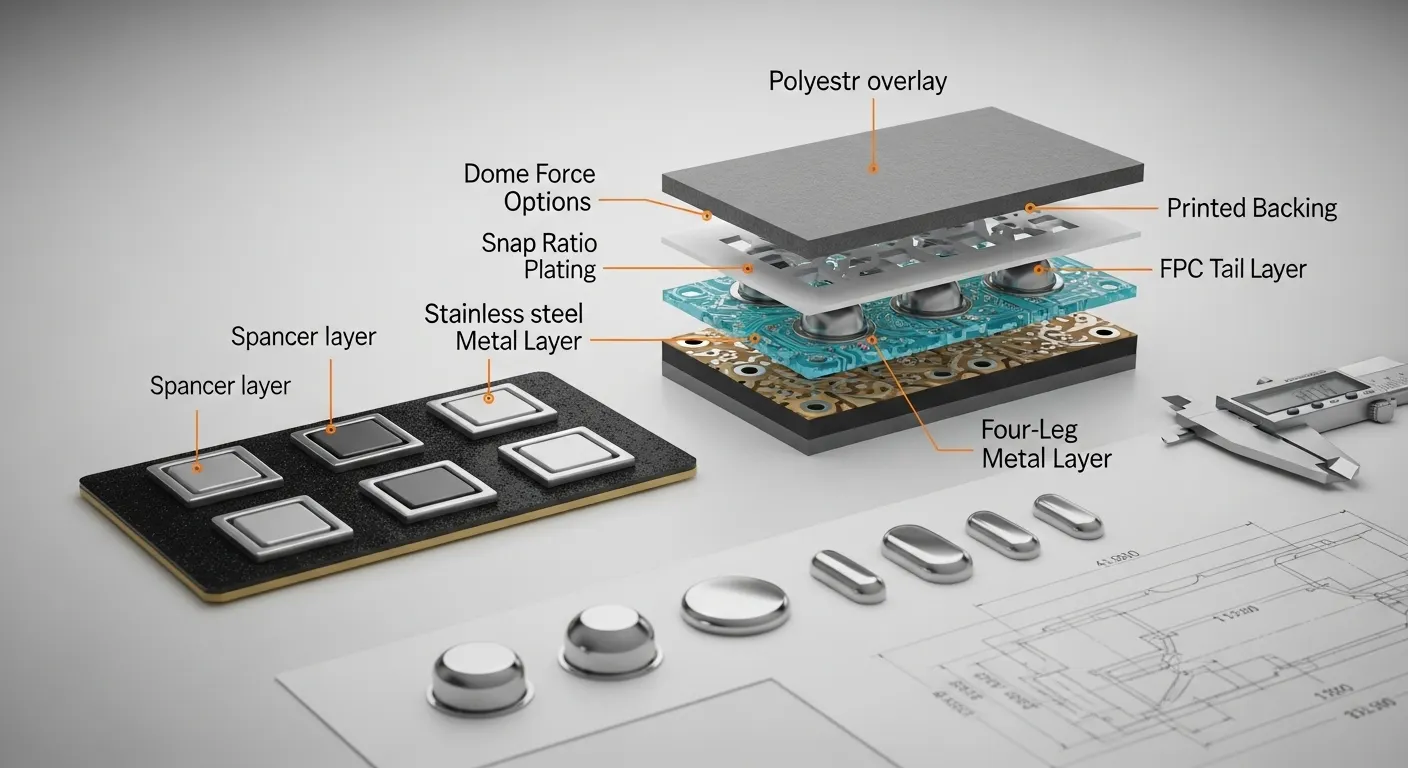
Choose a metal dome membrane switch when the operator needs clear tactile confirmation after pressing a key. The stainless steel dome collapses under pressure, closes the circuit, and returns with a snap feel after release.
This is useful when a flat printed membrane switch feels too soft, too uncertain, or too easy to activate by accident. Metal dome designs are common in equipment where users must know that a function has been triggered without looking closely at the panel.
Typical use cases include:
Metal domes usually cost more than simple polydome or non-tactile designs. However, they are often worth the cost when the product needs a sharper click, better operator confidence, and a longer service-life target.
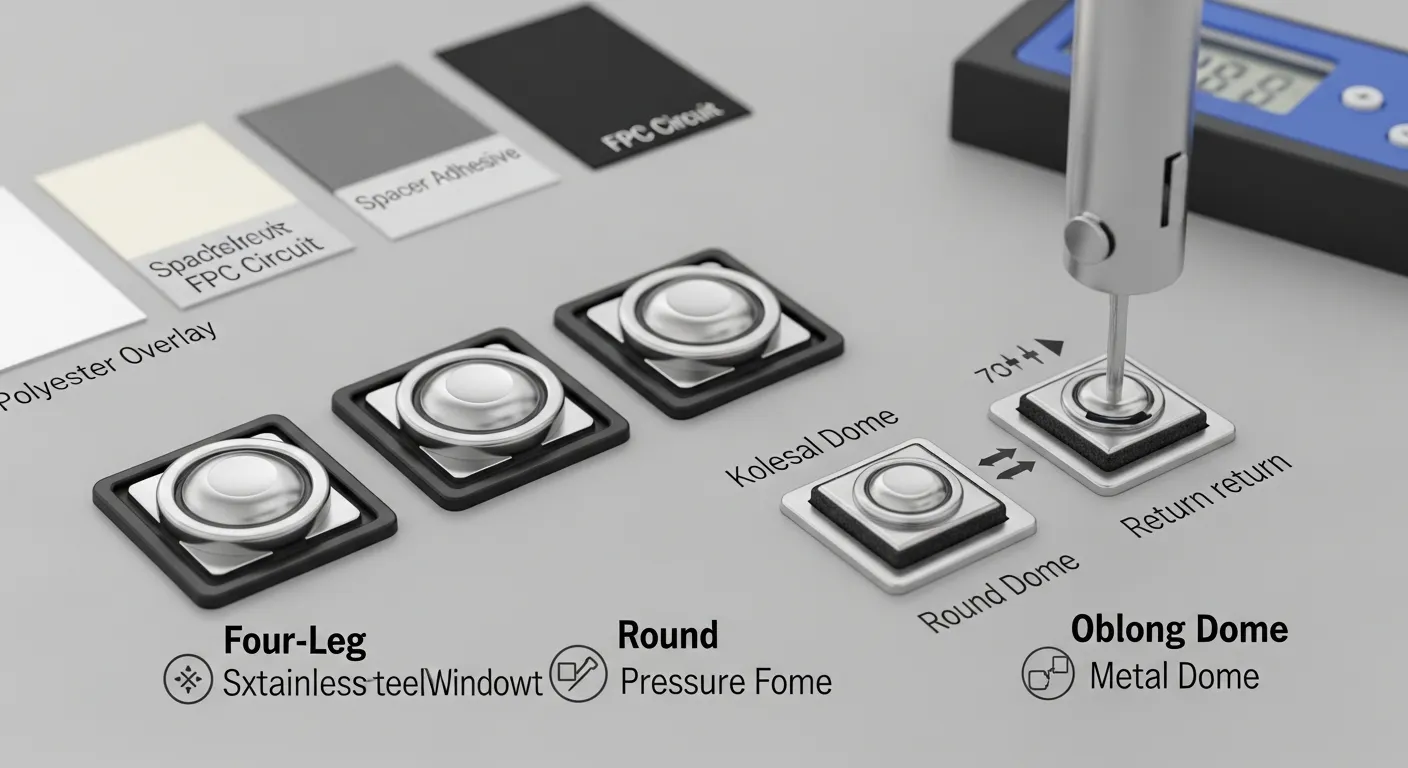
Click force is one of the first details to define. A dome that is too light can feel accidental. A dome that is too heavy can cause fatigue, especially on keypads with frequent input.
Niceone can review your button size, overlay material, embossing, spacer design, and use environment before recommending a force range. In many membrane switch projects, buyers compare several tactile samples before final approval.
| Dome force range | Typical feel | Best-fit use case | Buyer risk if mis-specified | RFQ note |
|---|---|---|---|---|
| Around 180g | Light, easy press | Frequent-use keys, handheld devices, small panels | May feel too light for gloved or high-vibration use | Good for comfort-focused interfaces |
| Around 280g | Balanced tactile click | General industrial, medical, instrumentation, appliance controls | May still need adjustment based on overlay stiffness | Often a practical starting point for sampling |
| 350g+ | Firm, deliberate press | Gloved use, outdoor panels, safety-confirmation keys | Can feel tiring for frequent data entry | Use when accidental activation must be reduced |
| Multiple sample forces | Side-by-side comparison | New product development and ergonomic approval | Slower decision if no target is defined | Best when tactile feel is subjective |
The selected force should match the real user. A technician wearing gloves on a factory floor may prefer a firmer key than a nurse using a bedside medical device. A large emergency stop-style membrane key may also need a different feel from a small menu button.
Dome shape affects contact area, feel, button size, and layout flexibility. The shape should not be chosen only from a catalog image. It should match the graphic overlay, circuit pad, button spacing, and available stack height.
Common options include:
For compact assemblies or curved routing, the dome may sit over a flexible printed circuit. For stronger support, lower resistance paths, or component integration, a PCB-based switch can be considered. For circuit-level decisions, see Niceone’s FPC keypad guide: https://www.niceone-keypad.com/flexible-printed-circuit-keypad-fpc/ and PCB membrane switch circuit page: https://www.niceone-keypad.com/pcb-membrane-switch-circuit-build/
Standard stainless steel domes are suitable for many keypad designs. For applications where contact stability matters more, nickel-plated or gold-plated domes may be considered.
Gold plating is often discussed when engineers want lower and more stable contact resistance. It can also be useful in sensitive circuits or environments where oxidation and long-term contact quality are concerns. Nickel plating may also be used depending on the electrical and cost target.
Plating should be specified with the full circuit design in mind. A gold-plated dome alone does not guarantee the whole keypad will perform well. The contact pad material, PCB or FPC design, adhesive cleanliness, spacer alignment, venting, and assembly process all affect final performance.
Use gold or nickel plating when the project has:
If the project is cost-sensitive and the electrical requirement is simple, a standard stainless steel dome may still be enough.
Two domes with the same actuation force can feel different. Snap ratio, sometimes called tactile ratio or click ratio, explains why.
A higher snap ratio usually feels sharper and more decisive. A lower snap ratio can feel softer or less distinct. The final feel also depends on overlay thickness, embossing height, adhesive thickness, dome travel, venting, and how much preload the design applies to the dome.
For a premium HMI, do not specify only “280g dome.” Also describe the desired feel:
Sampling is important because tactile feel is partly subjective. Niceone’s design team can help compare dome force and feel options before production, especially for new OEM projects.
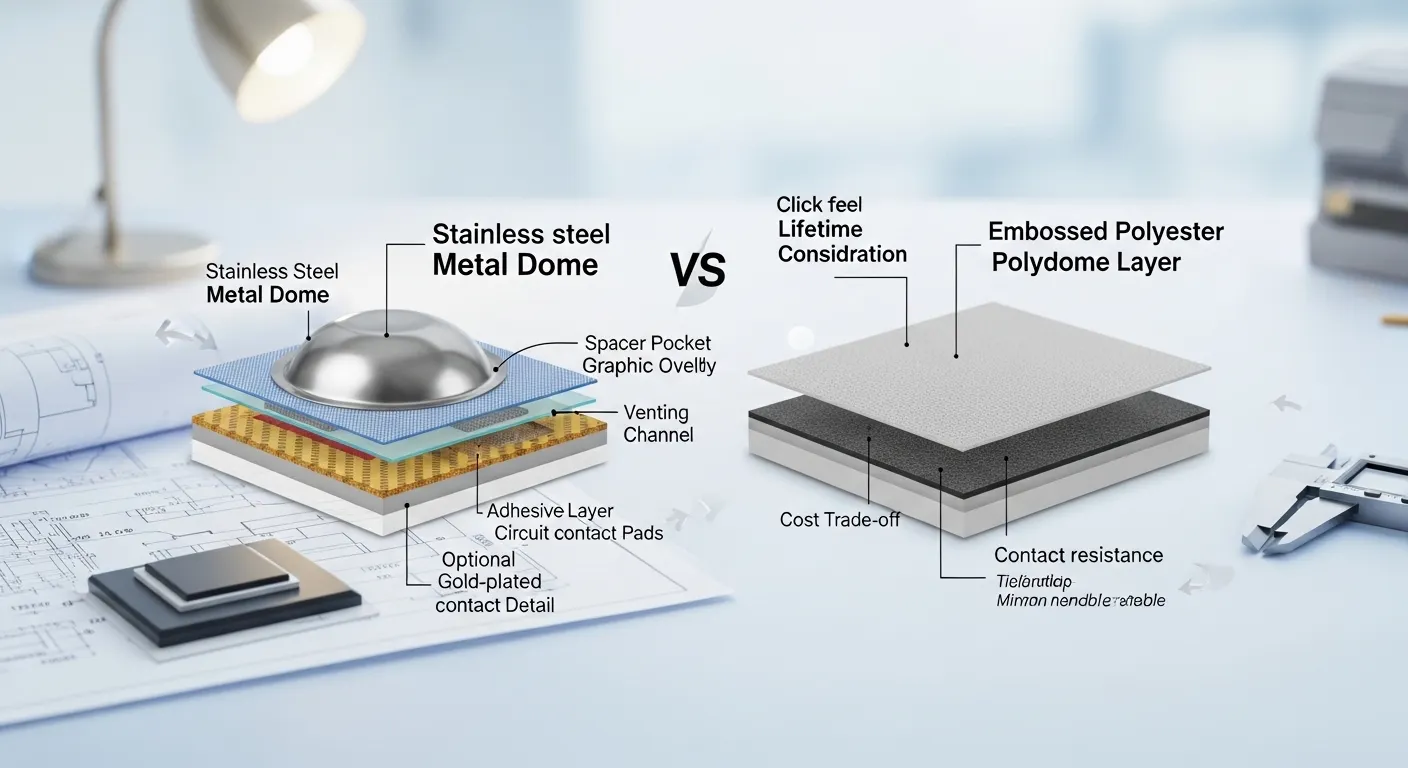
A metal dome and a polydome can both create tactile feedback, but they serve different design goals.
A metal dome is a separate stainless steel component placed inside the switch stack. It usually gives a sharper click and can support long-life product designs when specified correctly. For demanding applications, buyers may request 5M+ cycle dome options, but the actual rating must be confirmed per dome, design, and test condition.
A polydome is usually formed by embossing the polyester circuit or overlay layer. It can reduce cost and keep the stack thinner. However, it often feels softer and may not be the best choice for products that need long-term crisp tactile feedback.
Choose metal dome when:
Choose polydome when:
For many OEM projects, the decision is not only lifetime versus cost. It is also about user confidence, brand feel, and the cost of field service if the keypad becomes inconsistent.
A metal dome membrane switch must be designed as a full stack. The dome is only one layer. The surrounding structure controls how the dome moves, how air escapes, and how the contact closes.
Important design factors include:
A poorly vented dome can feel mushy or inconsistent. A stiff overlay can make a light dome feel heavier. A weak spacer design can affect travel and return feel. This is why a dome should be evaluated with the actual overlay and circuit stack, not only as a loose component.
A good RFQ helps the factory recommend the right dome and avoid unnecessary redesign. If the design is still open, Niceone can review the application and suggest options for sampling.
Send these details when possible:
For printed dome arrays or adhesive-mounted dome assemblies, you may also review Niceone’s dome label page: https://www.niceone-keypad.com/dome-label-custom-printing-decals/
Many projects start around 280g for a balanced tactile feel. Around 180g suits lighter frequent-use keys, while 350g+ is better for gloved use or deliberate activation. The best force depends on overlay stiffness, button size, and user environment.
Lifetime depends on dome supplier, force, shape, plating, circuit design, overlay, venting, and test conditions. For long-life designs, ask for dome options with the required cycle target instead of assuming every metal dome reaches the same rating.
Metal dome is usually better for crisp feedback and long-life tactile performance. Polydome can be better for lower cost and thinner designs. The right choice depends on product duty cycle, budget, panel thickness, and expected user experience.
Use plated domes when contact resistance stability, humidity resistance, or signal reliability is important. Gold plating may be useful for higher-value or sensitive control circuits. For simple cost-sensitive panels, standard stainless steel may be enough.
Yes. Metal domes can be designed over PET silver circuits, FPC circuits, or PCB-based switch circuits. The contact pad layout, spacer design, connector, and stack height should be reviewed together.
Common causes include poor venting, wrong force selection, dome misalignment, excessive overlay stiffness, adhesive contamination, or too much preload. Testing the dome with the real overlay and circuit stack helps prevent inconsistent feel.
Send Niceone-Keypad your drawing, keypad layout, target click force, dome shape preference, plating requirement, lifetime target, circuit type, connector details, overlay material, IP rating target, and operating environment. Our Dongguan factory and CT office can help review the specification, compare sample options, and prepare a custom metal dome membrane switch solution for your OEM project.
Do you have any questions, or would you like to speak directly with a representative?

