

Contact
Write to Us And We Would Be Happy to Advise You.
Do you have any questions, or would you like to speak directly with a representative?
By Fariha
Niceone-Keypad designs and manufactures low profile membrane switch assemblies for OEM engineers building handheld devices, wall-mount controllers, portable instruments, and compact HMI panels where stack height is a hard constraint. If your enclosure only allows a thin interface, the key decision is not just the graphic overlay material; it is the full stack-up: overlay, adhesive, spacer, circuit, tactile layer, backing, connector tail, and any sealing or backlighting layers.
This page helps product designers and hardware teams compare slim membrane keypad constructions before sending an RFQ. Niceone’s Dongguan factory supports custom membrane switches, FPC membrane switches, PCB-based membrane switches, tactile and non-tactile designs, graphic overlays, backlighting, and waterproof membrane panels, with US support through the CT office. Send your drawing, enclosure limit, key layout, and required feel, and our team can review the best slim HMI build direction.
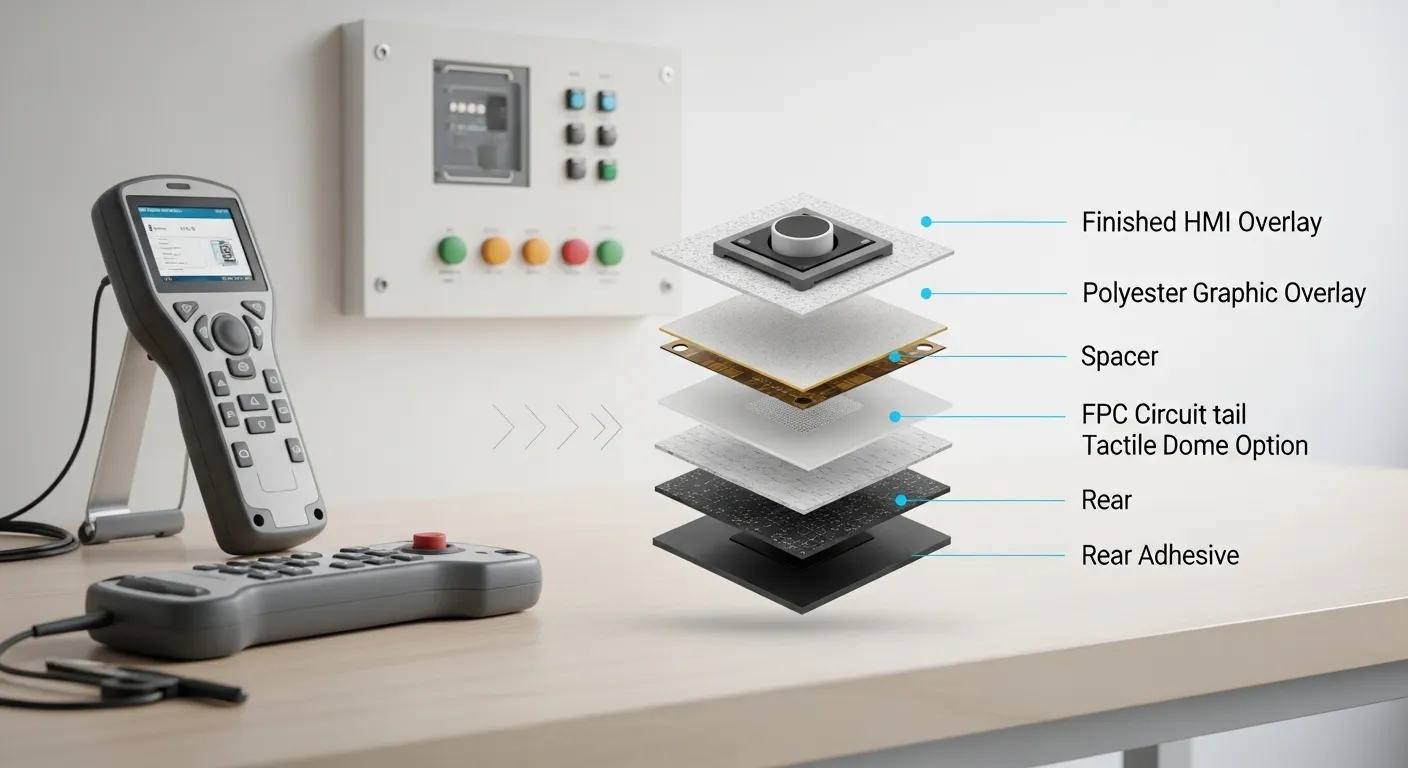
A low profile membrane switch can be designed for very slim HMI assemblies, but the final thickness depends on the full construction. A flat non-tactile switch, a polydome design, a metal dome tactile keypad, an FPC-based build, and a backlit sealed panel all use different layer combinations.
For sub-2mm designs, the most important question is: which features are essential, and which features can be simplified?
A typical slim membrane switch may include:
The switch may look thin on the drawing, but installed height can change after adhesive, gasket compression, enclosure recess depth, and tail routing are considered. That is why Niceone reviews the switch as part of the complete HMI assembly, not only as a flat printed part.
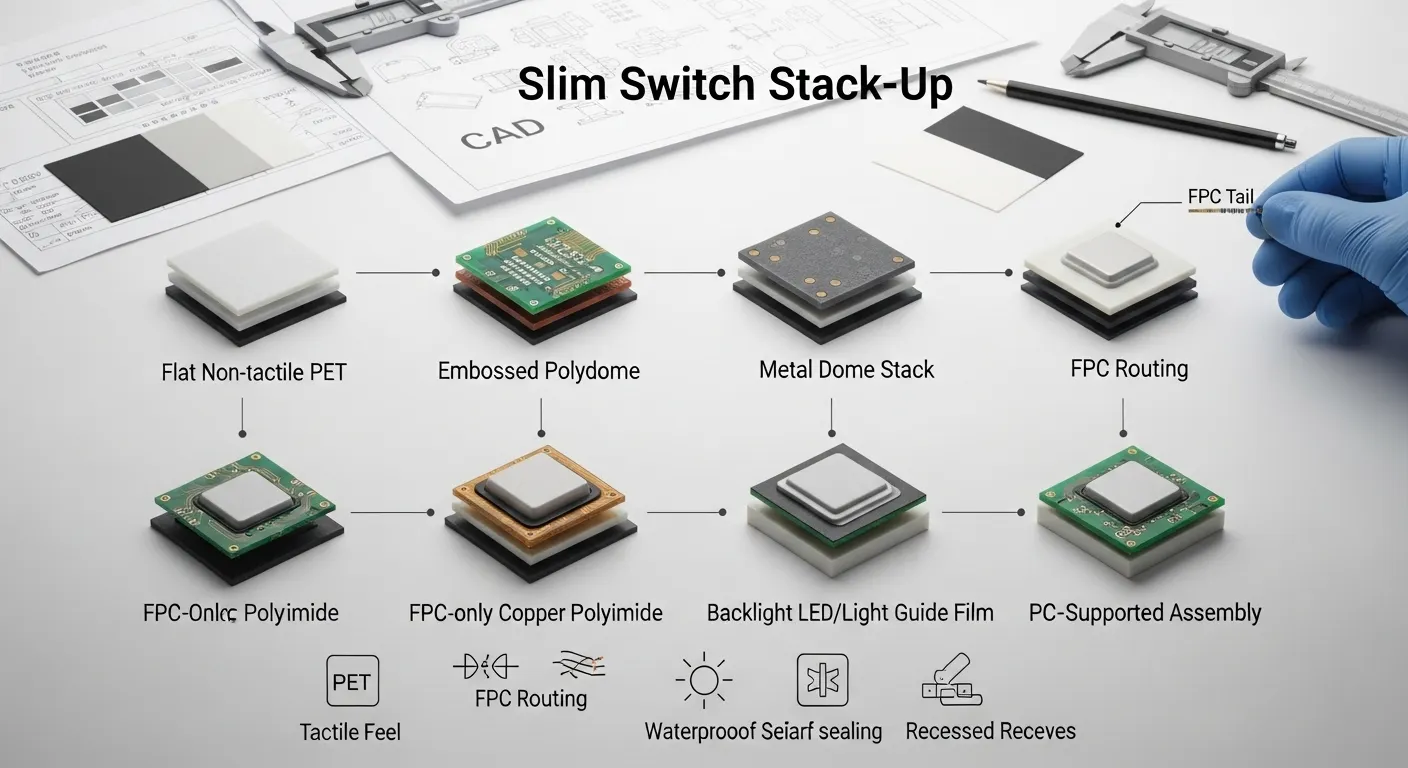
The right low profile membrane switch construction depends on the device, tactile requirement, and available enclosure depth. The table below gives a practical starting point for design discussion.
| Stack-up option | Typical construction logic | Main thickness driver | Tactile feel | Best-fit device type | Main tradeoff | RFQ detail to confirm |
|---|---|---|---|---|---|---|
| Flat non-tactile printed PET stack | Graphic overlay, spacer, printed PET circuit, rear adhesive | Overlay and adhesive thickness | Smooth press, no sharp click | Wall-mount panels, simple control surfaces | Less physical feedback | Whether visual or audio feedback is acceptable |
| Embossed or polydome PET stack | Overlay with embossed key area or formed polyester dome | Emboss height and spacer | Softer tactile response | Portable instruments, compact appliances | Feel is lighter than metal dome | Desired key travel and press feel |
| Metal dome tactile slim stack | Overlay, dome retainer, metal dome, printed circuit or FPC | Dome height and spacer design | Crisp tactile click | Industrial handhelds, test devices, control keypads | More stack height than flat design | Actuation force target and dome layout |
| FPC-only copper/polyimide stack | Thin overlay with flexible printed circuit tail | Circuit material and connector route | Tactile or non-tactile | Handheld scanners, compact electronics | Higher design precision needed | Tail bend path, pin count, connector pitch |
| Backlit slim stack | Overlay, circuit, LED or light guide layer, diffuser/window | Light guide, LED package, window area | Tactile or non-tactile | Dark-use instruments, medical or industrial panels | Adds optical and thickness complexity | Backlight zone, brightness, color, and power |
| PCB-supported or recessed rigid assembly | Overlay mounted over PCB or support plate | PCB/backer and enclosure recess | Tactile or capacitive options | Devices needing components behind the keypad | Rigid structure can increase depth | Board thickness, component height, recess depth |
If your design must stay close to a sub-2mm stack-up, start by deciding whether tactile feedback, illumination, and sealing are mandatory. Each one is possible, but each one consumes part of the mechanical budget.
Tactile feel becomes harder to control as the switch gets thinner. A flat non-tactile membrane panel is usually the simplest path for a slim front surface, but it does not give the user a clear click. This can work when the device has a screen prompt, LED indicator, buzzer, or software confirmation.
For a thinner tactile design, engineers may consider polydome or embossed polyester alternatives. These can reduce the need for a taller metal dome construction, but the feel is softer. They are useful when the interface needs light feedback without a sharp snap.
Metal domes are still common when the user needs a clear tactile response. However, the dome shape, retainer layer, spacer design, and overlay embossing must be reviewed together. A strong click may require more height than a soft press.
Key tactile items to define before quoting:
FPC construction is often useful when the HMI must stay thin and route into a crowded enclosure. A flexible printed circuit can help with tight bend paths, compact connector locations, and fine-pitch layouts. It can also support more complex routing than a simple printed silver PET circuit.
Printed PET circuits can still be suitable for many low profile membrane keypad designs. They are often used when the layout is simple, the tail path is not aggressive, and the electrical requirements are straightforward.
PCB-based membrane switches are useful when the keypad needs stronger support, mounted components, discrete wires, or a rigid electronic base. However, PCB thickness and component height must be included in the full enclosure design.
Choose FPC when the design needs:
Choose printed PET when the keypad is simpler and the circuit can remain flat. Choose PCB when the electronics behind the interface need a rigid platform.
The graphic overlay is the visible layer, but it is not the only layer that affects thickness. Overlay material, surface texture, hardcoat, adhesive, spacer, and rear mounting method all change the finished HMI profile.
Polyester overlays are common for membrane switches because they support flexing and repeated key actuation. Polycarbonate can also be used for graphic overlays, especially when appearance, clarity, or forming needs are different. The final material choice should match the key action, environment, print design, window area, and surface finish.
Adhesive selection matters as much as the overlay. The mounting surface may be plastic, coated metal, stainless steel, aluminum, painted housing, or another substrate. A low profile design can fail if the adhesive is not matched to the enclosure surface.
Confirm these mounting details early:
For slim devices, a recessed enclosure can help protect the overlay while controlling installed height. However, the recess must allow for adhesive, overlay thickness, and any raised key embossing.
A low-profile membrane switch can include lighting or sealing, but both features must be planned from the beginning. Adding them late can change the stack height, layout, and tooling direction.
Backlighting may use LED, light guide film, fiber optic, or indicator-window designs. A simple LED indicator usually affects the stack less than a full illuminated keypad area. Light guide film can improve light distribution, but it adds optical design requirements. For more detail, see Niceone’s backlit membrane switch panel options.
Waterproof or dust-resistant construction also needs full assembly review. The overlay, perimeter adhesive, cable exit, connector path, gasket, and enclosure interface all affect sealing. An IP65 or IP67 target should be treated as a design requirement that must be confirmed for the final assembly. For sealed HMI design, see Niceone’s waterproof membrane switch panels.
When thinness, backlighting, and sealing are all required, the design team should prioritize the constraints in order. For example, a handheld field device may need sealing first, tactile feel second, and full-area lighting third.
Low profile membrane switches are useful when the user interface must stay flat, sealed, lightweight, and easy to integrate into a compact product housing.
Common applications include:
For these devices, the switch is not only a front label. It is part of the mechanical, electrical, and user-experience design. The buyer must balance thickness, touch feel, sealing, graphics, backlighting, and assembly method before production.
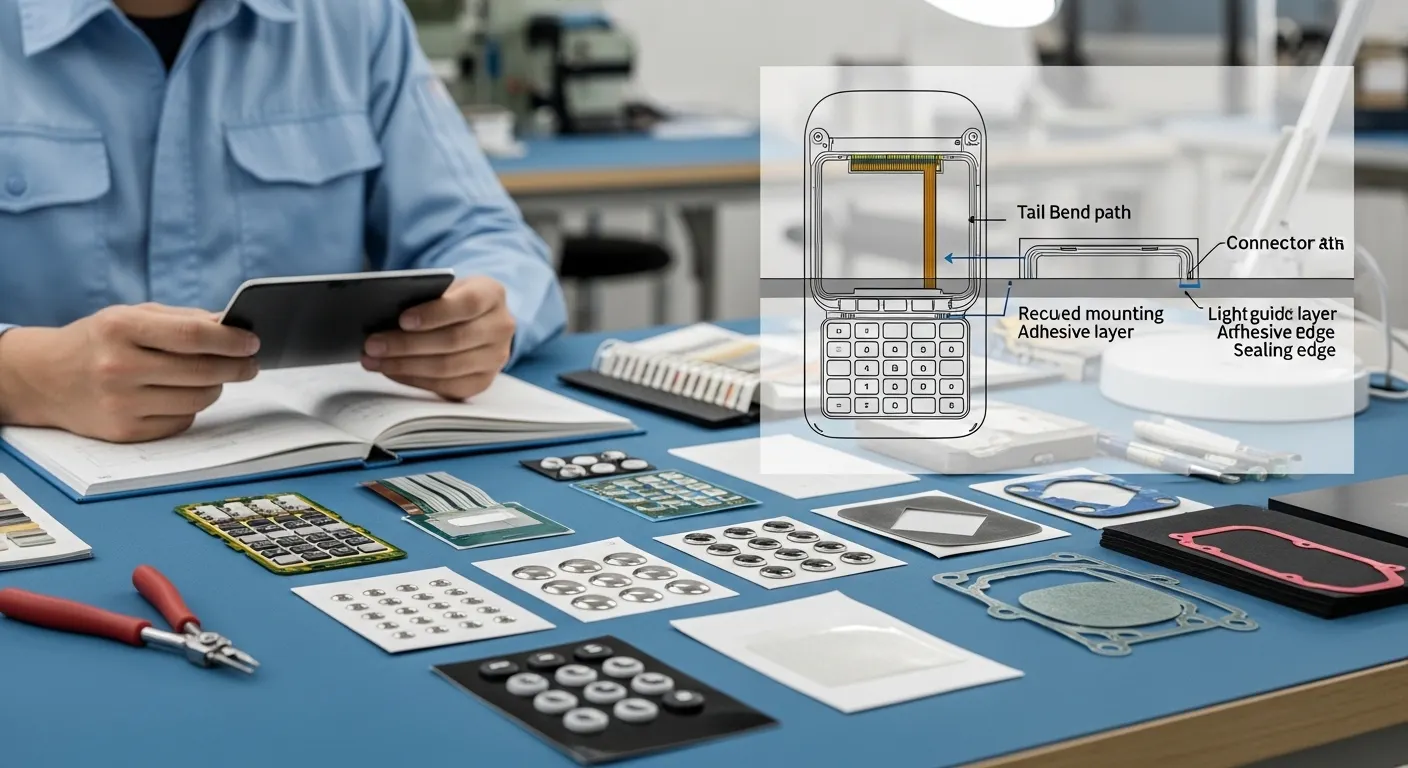
A slim membrane switch quote is more accurate when the mechanical limits are clear. If the enclosure is still in design, send the available drawings and describe the maximum allowed thickness.
For a low-profile HMI review, send:
Niceone can review the design from the perspective of stack height, manufacturability, and assembly fit. If you are unsure whether FPC, printed PET, or PCB is best, send the enclosure limits first. The circuit construction can be selected after the mechanical constraints are understood.
It depends on the overlay, spacer, circuit, dome, adhesive, backing, and optional features. A flat non-tactile design is usually thinner than a metal dome, backlit, or heavily sealed design. Share your maximum installed height for review.
Not always. A slim metal dome design may be possible, but polydome, embossed polyester, or non-tactile construction can reduce height. The best option depends on key feel, key size, and enclosure space.
FPC is useful for tight routing, fine pitch, compact electronics, and bend paths inside small enclosures. Printed PET may be enough for simpler flat keypads. Niceone can review both options during RFQ.
Yes, but lighting adds design complexity. LED indicators, light guide film, fiber optic, or window lighting can be considered. The best method depends on brightness, power, lighting area, and available stack height.
A slim switch can be designed toward waterproof or dust-proof requirements, but sealing is not automatic. The perimeter adhesive, cable exit, gasket, enclosure interface, and final assembly all affect IP performance.
Send the enclosure drawing, maximum height, artwork, key layout, tactile preference, circuit preference, connector details, backlight needs, IP target, and mounting surface material. These details help Niceone recommend the right stack-up.
If your handheld, wall-mount, or portable device needs a low profile membrane switch, send Niceone-Keypad your drawing, target installed height, enclosure recess, key layout, tactile preference, circuit requirement, connector details, and any backlighting or waterproof target.
Our Dongguan production team and CT office can help review the stack-up direction, compare FPC, printed PET, and PCB options, and prepare a custom RFQ for your slim HMI build.
Do you have any questions, or would you like to speak directly with a representative?

