

Contact
Write to Us And We Would Be Happy to Advise You.
Do you have any questions, or would you like to speak directly with a representative?
By Fariha
Niceone-Keypad designs and manufactures custom waterproof membrane switch panels for OEM engineers, hardware designers, and procurement teams specifying sealed HMI controls for outdoor, washdown, marine, industrial, agricultural, medical, and food-processing equipment. If your project needs IP65, IP67, IP68, or IP69K-style protection, our team can review the panel layout, overlay material, circuit structure, gasket area, tail exit, connector position, and test requirement before production.
A waterproof membrane panel is not sealed by the graphic overlay alone. Real ingress protection depends on the full stack: polyester or polycarbonate overlay, adhesive system, spacer layer, circuit, tail routing, gasket design, mounting surface, and any LED or display-window openings.
This page helps engineers choose the right IP rating, compare sealing methods, and prepare an accurate RFQ for a custom sealed membrane switch panel made through Niceone’s Dongguan factory, with US communication support through our Redding, CT office.
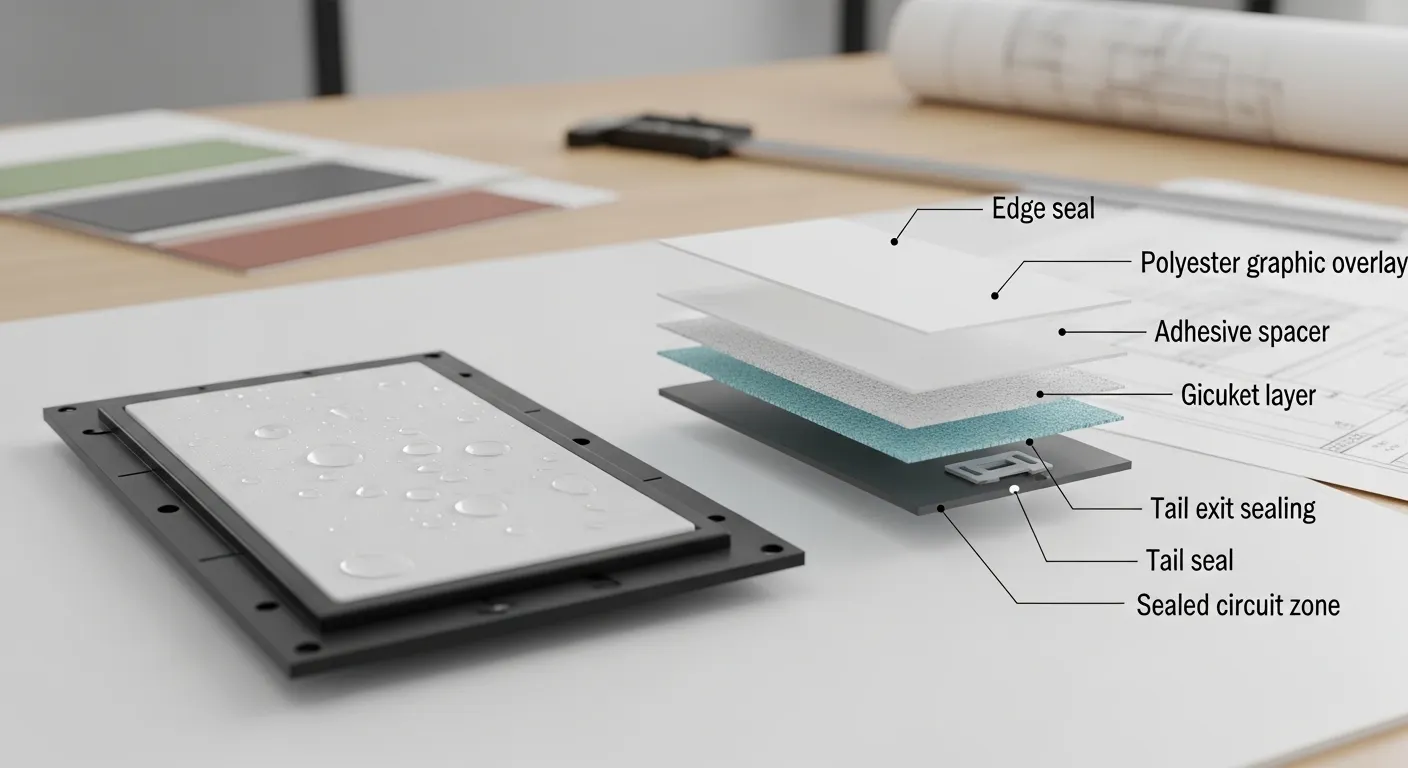
The right IP rating depends on the actual exposure, not only the word “waterproof.” A control panel used outdoors under rain may not need the same construction as a keypad cleaned with high-pressure hot water.
For membrane switch panels, the most common waterproof targets are:
For IP67 and IP69K-style projects, the membrane switch should be reviewed as part of the full installed assembly. The gasket, enclosure, screw compression, tail exit, and connector path can all affect final performance.
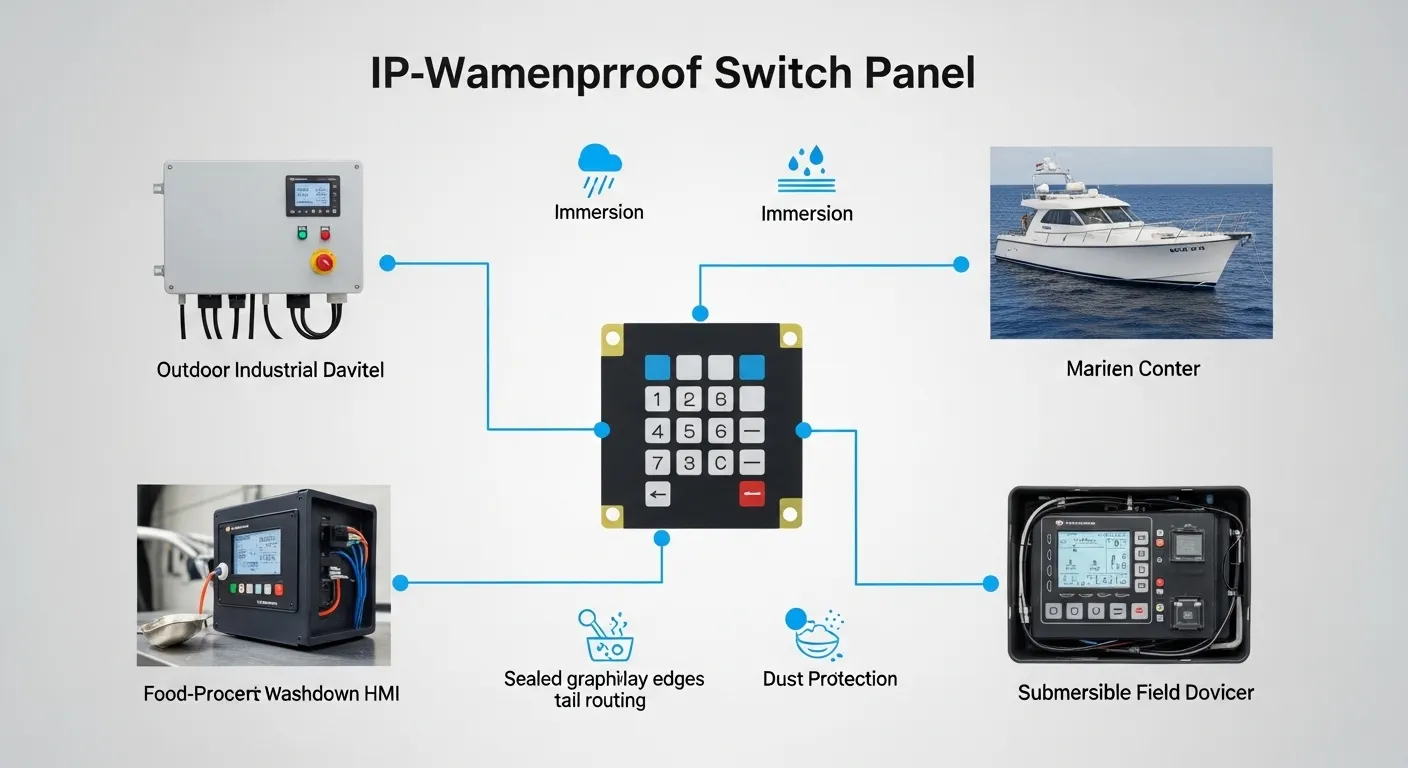
| Application / environment | Exposure type | Suggested IP target | Main ingress risk | Recommended sealing focus | Test / documentation note |
|---|---|---|---|---|---|
| Outdoor industrial control panel | Rain, dust, splash, UV | IP65 / IP66 | Overlay edge, enclosure gap | Edge-sealed overlay, perimeter gasket, UV-resistant material | Confirm water-jet direction and mounting condition |
| Marine console or agricultural equipment | Rain, mud, spray, humidity | IP65 / IP67 | Tail exit, connector, salt/moisture path | Silicone surround, sealed tail exit, corrosion-aware connector choice | Consider chemical and salt exposure separately |
| Portable field device | Drop into water, short immersion | IP67 | Tail breakout, adhesive edge, display window | Waterproof frame, gasket compression, tail potting | Define immersion depth and time |
| Food-processing machine HMI | Detergent, hose-down, sanitation wash | IP66 / IP69K-style | Button edge, LED window, enclosure seam | Silicone gasket, welded or sealed edge, chemical-resistant overlay | Confirm detergent and wash temperature |
| Submersible or near-submersible control | Standing water, repeated immersion | IP68-style | Long-term adhesive creep, connector route | Fully sealed stack, controlled tail exit, validated assembly | Define depth, duration, and test sample condition |
| Backlit outdoor panel | Rain, dust, light window exposure | IP65 / IP67 | LED window, light guide edge | Sealed LED windows, OCA/LOCA bonding, controlled light-guide path | Review illumination and sealing together |
This table should guide the first design discussion. The final rating depends on the enclosure, mounting pressure, gasket width, material stack, and whether the customer needs third-party test evidence.
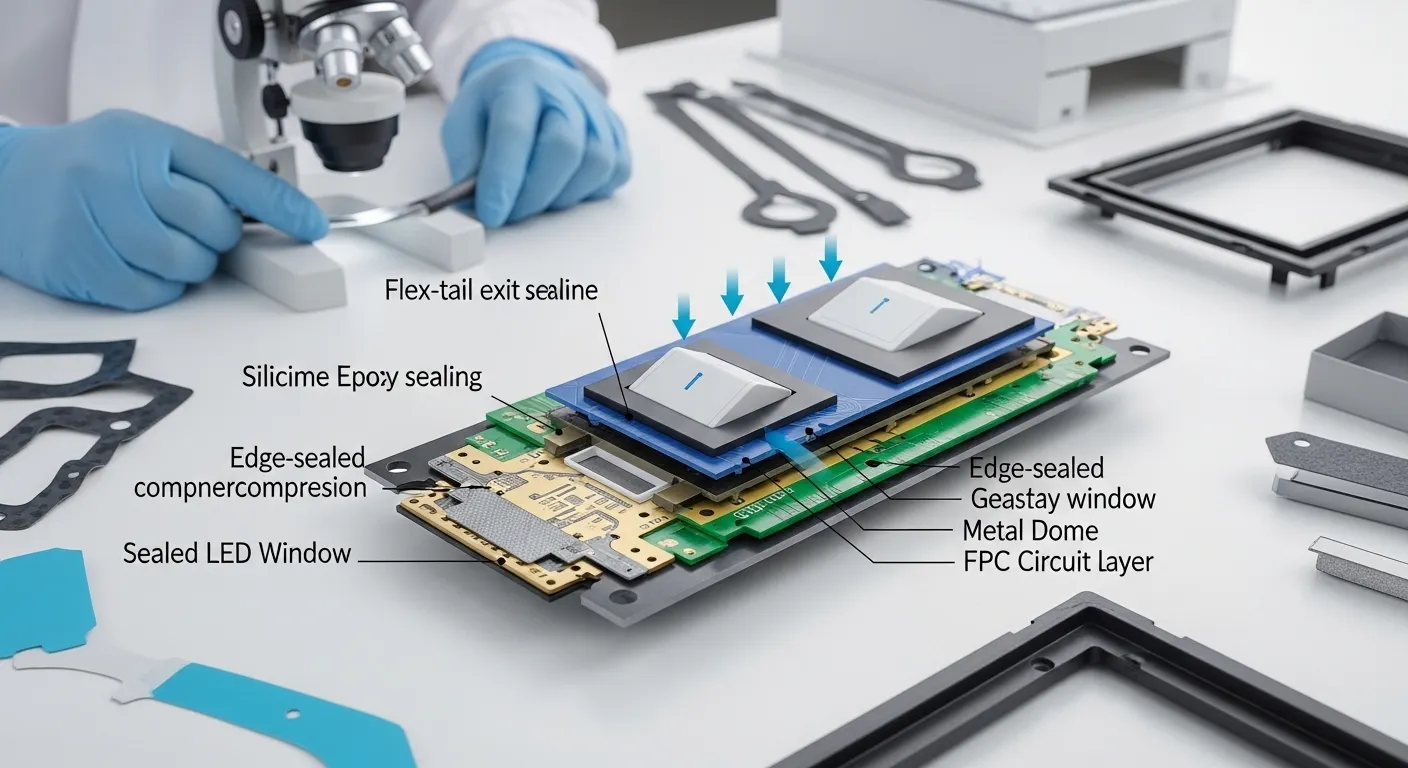
Most water failures begin at the weakest path, not the largest surface. The flat overlay may look sealed, but liquid can still move through small gaps by capillary action.
Common ingress points include:
Niceone can review the panel outline, button layout, LED position, and tail route before tooling. For waterproof designs, it is better to adjust the layout early than fix a leakage path after samples are built.
Different waterproof membrane switch panels need different sealing methods. A simple outdoor panel may use an edge-sealed overlay and gasket. A washdown keypad may need silicone, welding, potting, or a more controlled waterproof frame.
Common sealing options include:
No single method fits every project. For example, a thin outdoor graphic overlay may not need the same construction as a food-processing keypad exposed to hot washdown and detergent.
Material selection affects sealing, durability, appearance, and cost. The best structure depends on exposure, panel size, tactile feel, and installation method.
For the overlay, buyers commonly choose:
For the circuit layer, options may include:
Engineers should also confirm connector type, pinout, tail length, bend radius, ESD or RFI shielding needs, adhesive preference, and operating environment. These details affect both waterproofing and manufacturability.
Yes. Waterproof membrane panels can include tactile domes, LED backlighting, light guide film, fiber optic backlighting, capacitive areas, display windows, and embossed keys. The important point is to design the sealed structure around those features from the start.
For tactile feedback, the dome area must be protected without blocking actuation feel. Metal domes, polydomes, embossing style, and actuation force should be selected together with the spacer and gasket design.
For backlit panels, the LED window, icon area, and light-guide path need careful sealing. Outdoor and washdown panels may need sealed LED pockets, controlled adhesive layers, and clear window bonding. For more detail on illumination options, see Niceone’s backlit membrane switch panels.
Display windows also need early review. OCA or LOCA bonding may help reduce visual gaps and water paths, but the final choice depends on the display type, cleaning exposure, and enclosure design.
For lower-risk splash or water-jet applications, many buyers use internal validation during prototype review. For IP67, IP68, or IP69K-style requirements, procurement teams may need third-party test documentation or project-specific validation.
The test requirement should define:
This is especially important for food-processing, marine, medical, industrial, and transportation equipment. A membrane switch tested as a loose part may perform differently after installation, so the enclosure interface should be part of the discussion.
A good RFQ helps Niceone recommend the right sealing method before tooling. Send as much practical detail as possible, even if the design is still early.
For a waterproof panel review, include:
If you are still comparing layouts, you can also review Niceone’s membrane switch design examples gallery before preparing files.
Often, yes. IP67 is useful when temporary immersion or water pooling is possible. For simple rain and splash exposure, IP65 or IP66 may be enough. The enclosure, gasket, and tail exit still need review.
IP67 focuses on temporary immersion. IP69K-style protection focuses on high-pressure, high-temperature washdown. One is not always better than the other; they address different water risks.
The flex-tail exit is often the most sensitive area. Other risks include the panel edge, connector route, display window, LED opening, and uneven mounting surface.
Yes. LED backlighting, light guide film, and sealed windows can be included if the backlight structure is designed with the gasket, adhesive, and overlay stack from the beginning.
For IP67, IP68, or IP69K-style projects, many OEMs request third-party test evidence. Confirm this before quoting, because test samples, mounted conditions, and documentation requirements affect the project plan.
Send drawings, artwork, circuit details, tail and connector requirements, target IP rating, exposure conditions, mounting method, and any LED, display, shielding, or testing requirements.
If your HMI will face rain, washdown, immersion, humidity, dust, chemicals, or outdoor exposure, send your drawings to Niceone-Keypad for a waterproof membrane switch panel review. Our team can check the IP target, sealing margin, gasket approach, tail exit, overlay material, circuit choice, LED or display-window design, and documentation needs before production.
For the fastest review, include your target IP rating, application environment, panel drawing, artwork, circuit/pinout, connector details, mounting surface, backlighting needs, and any third-party test requirement. Niceone’s Dongguan factory and CT office can support custom sealed membrane switch projects from design review to sample and production discussion.
Do you have any questions, or would you like to speak directly with a representative?

