

Contact
Write to Us And We Would Be Happy to Advise You.
Do you have any questions, or would you like to speak directly with a representative?
By Fariha
A stainless steel membrane switch interface combines a metal-faced front panel with a custom membrane circuit, FPC, PCB, or tactile dome construction. It is usually specified when a standard PC or PET graphic overlay may not provide enough abrasion resistance, washdown durability, public-touch strength, or hygienic surface performance.
For engineers designing food equipment, medical or lab devices, outdoor kiosks, industrial machinery, or public terminals, stainless steel can be a strong interface choice. The tradeoff is that the material decision must happen early. Stainless grade, surface finish, tactile feel, sealing method, display windows, capacitive sensing, and mounting details all affect the final design and quote.
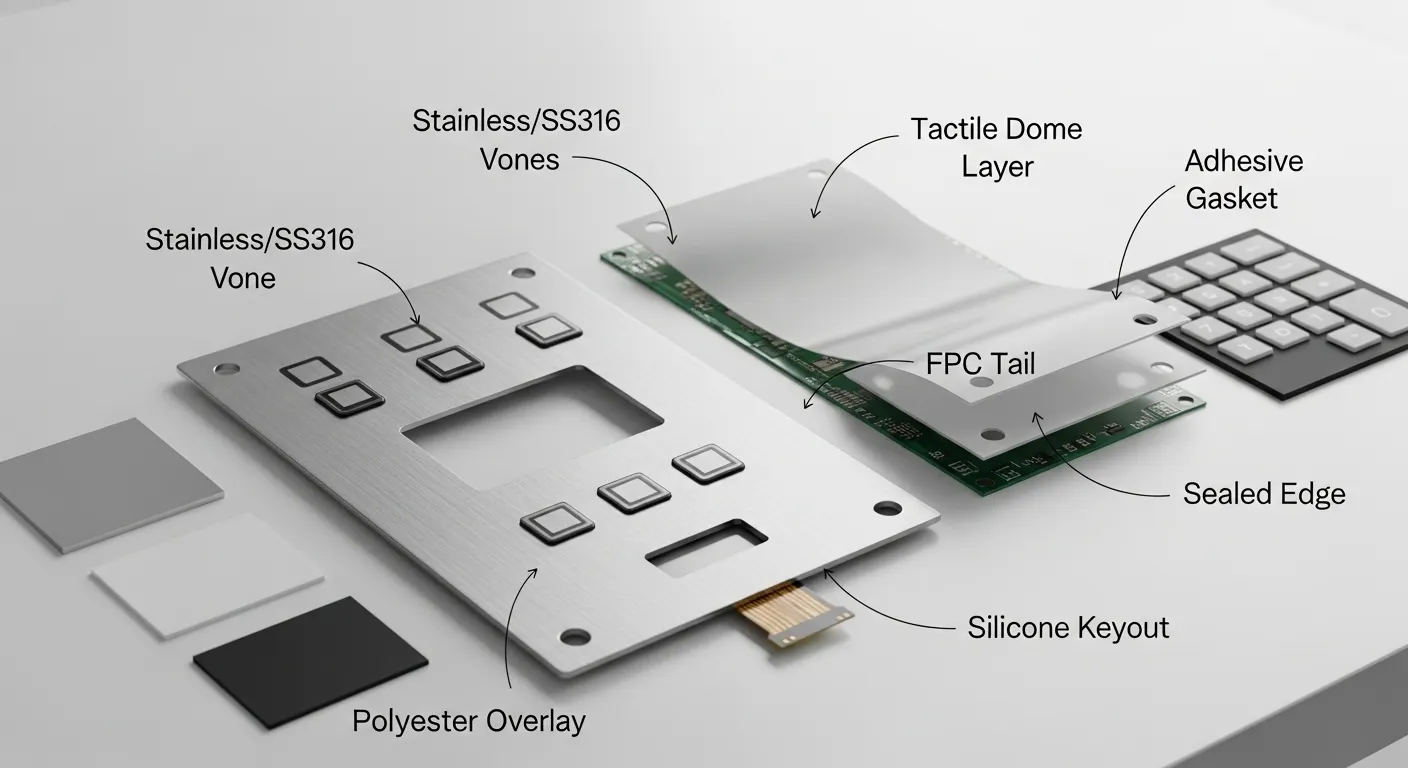
A stainless steel membrane switch interface is best suited for applications where the front surface must resist repeated contact, cleaning, moisture, chemicals, abrasion, or public use. Unlike a standard printed PC or PET overlay, the stainless face can provide a more rugged and premium surface for harsh or sanitary environments.
Typical use cases include:
Stainless is not always the best choice. If the product needs complex full-color graphics, very low cost, wide illuminated areas, or an ultra-light front stack, a PC or PET overlay may still be better. For sealed designs where water resistance is the main requirement, buyers should also review waterproof membrane switch panel options before deciding that stainless is necessary.
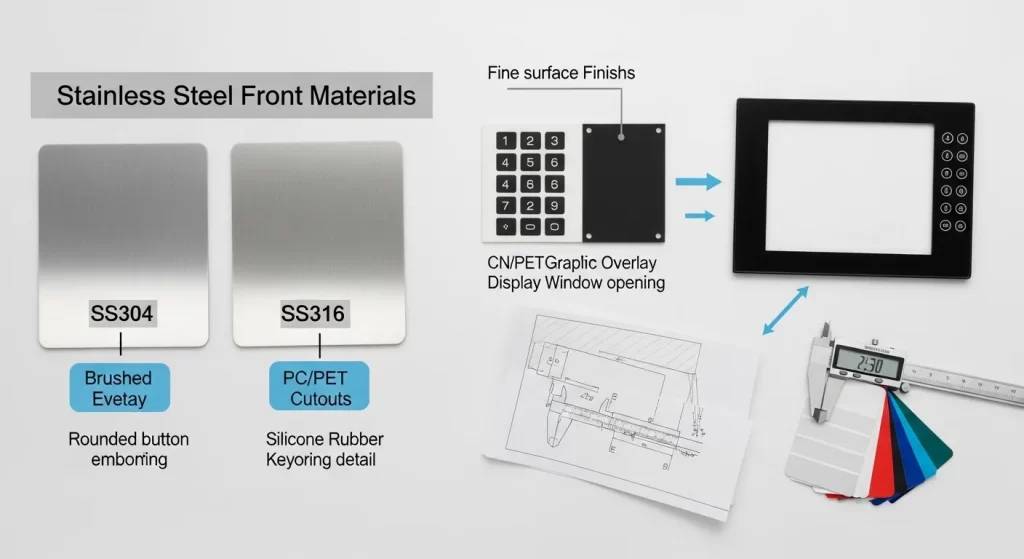
SS304 and SS316 are the two stainless options buyers most often consider for stainless-faced HMI panels. The right choice depends on corrosion exposure, cleaning chemicals, application environment, and documentation needs.
SS304 is commonly considered for general industrial, public-touch, and sanitary equipment applications where the panel needs a clean metal surface but is not exposed to severe chloride, salt, or aggressive chemical environments.
SS316 is usually considered when corrosion resistance is more critical. It may be more suitable for marine-adjacent equipment, stronger washdown conditions, chloride exposure, salt air, or food-processing environments where cleaning chemicals are a major design concern.
The RFQ should not simply say “stainless steel.” It should specify the required grade if the grade matters. If the buyer is unsure, the application environment, cleaning method, and corrosion concerns should be shared so Niceone-Keypad can review the interface direction during the design discussion.
A stainless-faced interface can still support tactile feedback, but the feel will not be identical to a thin polyester overlay. The stainless face, spacer layers, dome type, support plate, and key geometry all influence the actuation force and click response.
For tactile designs, engineers should define the expected user experience early:
Stainless steel can be formed or embossed in some designs, but embossing height, key size, bend radius, and tolerance must be reviewed carefully. A metal face also requires accurate alignment between the key graphics, dome position, spacer layer, circuit contacts, and mounting structure.
It is also important to separate two different ideas: a stainless steel front interface is the visible metal surface, while a stainless steel metal dome is an internal tactile contact component. A design may use one, both, or neither depending on the required interface style.
If the buyer is also trying to keep the final HMI very thin, the stainless face should be reviewed together with the total stack height. In that case, Niceone’s low-profile membrane switch design guidance may be relevant.
Capacitive sensing through stainless steel is not the same as standard capacitive touch through glass, acrylic, PC, or PET. Because stainless is conductive, the sensing structure must be engineered differently.
In some metal-touch designs, the system may rely on micro-deflection of the stainless surface, spacer geometry, grounding strategy, PCB electrode layout, and controller tuning. This means the mechanical structure and electrical design must be reviewed together. Panel thickness, support method, grounding, water exposure, gloves, electrical noise, and environmental drift can all affect performance.
For this reason, buyers should not treat capacitive-through-stainless as a simple checkbox. If the project requires capacitive sensing, the RFQ should clearly state:
For many stainless-faced panels, tactile metal dome input may be more practical than capacitive input. For other projects, a hybrid construction may be worth reviewing during the design stage.
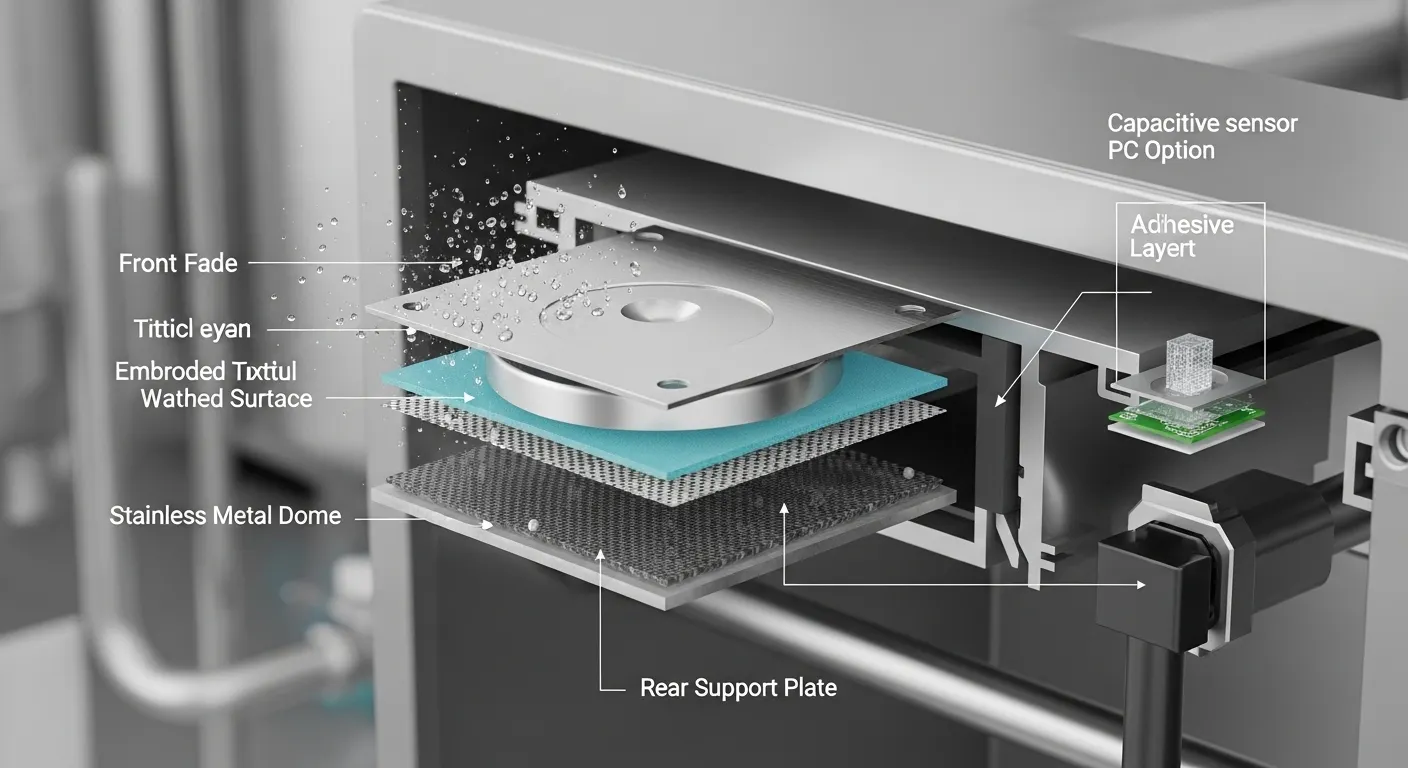
Stainless steel improves the front surface, but it does not automatically make a membrane switch IP65, IP67, or IP69K. Water resistance depends on the complete panel assembly, not only the face material.
Important sealing details include:
If the application requires an IP-rated panel, the buyer should specify the target rating and the real operating conditions. For example, an indoor splash-resistant panel, a food washdown control panel, and an outdoor kiosk exposed to rain are not the same design problem. Niceone’s waterproof membrane switch panel page is the more relevant internal reference when sealing is the primary requirement.
A stainless face can provide a stronger, more durable, and more premium surface than a printed PC or PET overlay. However, it can also increase cost, weight, design review time, and manufacturing complexity. The best material depends on the application environment and user interaction.
| Decision factor | SS304 stainless face | SS316 stainless face | PC/PET overlay | Silicone rubber keypad | RFQ note for Niceone |
|---|---|---|---|---|---|
| Best-fit environment | General industrial, public-touch, sanitary panels | Harsher corrosion, chloride, salt, or chemical exposure | General equipment panels with printed graphics | Keypads needing soft touch, raised keys, or molded shapes | Describe the actual use environment |
| Cost level | Higher than PC/PET | Usually higher than SS304 | Usually lower | Depends on mold and keypad complexity | Share target volume and budget sensitivity |
| Tactile feel | Firm, engineered feel possible | Firm, engineered feel possible | Good tactile feel with domes and embossing | Soft, molded key feel | Specify dome force or user feel target |
| Graphics and legends | More limited than full-color overlays | More limited than full-color overlays | Strong for colors, icons, windows, and branding | Good for molded icons and colored keys | Send artwork and marking requirements |
| Backlighting | Requires planned windows or light paths | Requires planned windows or light paths | Works well with LEDs, LGF, or window areas | Can support backlit key areas depending on design | Identify LED, window, or legend lighting needs |
| Washdown design | Good candidate when sealing is properly designed | Better candidate for harsher corrosion concerns | Possible with correct sealing and material selection | Possible, depending on housing and seal design | Specify IP target and cleaning method |
If illuminated legends, LED indicators, or display windows are important, review the lighting concept early. A stainless face may require dedicated windows, cutouts, or hybrid construction, while PC/PET overlays can be easier for broader graphic and backlighting effects. For lighting-focused projects, see backlit membrane switch panel options.
Stainless-faced membrane interfaces are most useful when the interface surface must remain clean, durable, and reliable under repeated contact. The material is often chosen less for decoration and more for practical field conditions.
Food-processing machinery may need a front panel that resists frequent cleaning, moisture, and operator contact. In these cases, the stainless grade, sealing method, gasket design, and chemical exposure should be discussed before quoting.
Medical and lab equipment often requires smooth, easy-to-clean surfaces. However, the writer should avoid calling the interface “medical-grade” unless the material, test, or certification basis is clearly confirmed. The safer focus is cleanability, surface durability, and custom HMI design.
Outdoor and public-touch equipment can face abrasion, weather, impact, and repeated use. Stainless may help create a more rugged interface, but sealing, window design, UV exposure, connector protection, and housing integration still matter.
Industrial equipment may require a firm tactile feel, glove operation, chemical resistance, and long-term surface durability. In these projects, key spacing, dome force, tail exit, rear support, and mounting method should be part of the design review.
A stainless interface RFQ should include more than a drawing and quantity. The more complete the project information, the easier it is to review material, construction, sealing, and cost tradeoffs.
Useful RFQ inputs include:
Niceone-Keypad can review stainless-faced membrane switch interface projects from both a technical and manufacturing perspective. For US-based coordination, buyers can also reference Niceone’s Redding, Connecticut office while the Dongguan factory supports custom membrane switch and HMI manufacturing.
No. A stainless steel membrane switch interface usually refers to the visible stainless front face or overlay. A stainless steel dome switch refers to the internal tactile dome used to create the click feel. A project may use a stainless face, stainless domes, both, or neither.
SS304 may be suitable for many general sanitary or industrial applications. SS316 is usually considered when corrosion, chloride, salt, or harsher cleaning exposure is a larger concern. The RFQ should include the cleaning method and environment so the grade can be reviewed.
Yes, tactile feedback may be designed with metal domes, spacer layers, and controlled key geometry. The final feel depends on stainless thickness, dome force, stack-up, key size, and rear support. Buyers should describe the desired key feel during RFQ.
They may be possible in special touch-through-metal designs, but they are not the same as standard capacitive touch through PC or glass. The structure may require metal deflection, spacer control, grounding, PCB electrode design, and controller tuning.
No. IP performance depends on the full assembly, including adhesive, gasket, tail exit, connector location, windows, mounting holes, rear housing, and testing. Stainless steel improves the front surface but does not guarantee a rating by itself.
Send available drawings, dimensions, artwork, stainless grade or finish preference, touch method, IP target, cleaning exposure, connector or tail requirements, mounting details, backlighting or window needs, prototype quantity, and expected production volume.
Do you have any questions, or would you like to speak directly with a representative?

