

Contact
Write to Us And We Would Be Happy to Advise You.
Do you have any questions, or would you like to speak directly with a representative?
By Fariha
Niceone-Keypad manufactures custom polycarbonate membrane switch overlays for OEM product engineers, hardware design teams, and procurement buyers who need the right graphic overlay material before releasing a new HMI build. Polycarbonate, often called PC, is useful when the membrane panel needs clear windows, crisp graphics, controlled embossing, and a premium visual finish, but it is not always the best choice for chemicals, heavy cleaning, or very high-use tactile keys.
This page helps you compare PC, PET polyester, and textured or hard-coated overlay options before you send an RFQ. The right decision depends on the application, surface finish, actuation frequency, cleaning method, UV exposure, backlighting, adhesive, IP-rating target, and compliance requirements.
Niceone supports custom membrane keypads, graphic overlays, FPC membrane switches, PCB-based membrane switches, tactile domes, backlit panels, and waterproof membrane switch assemblies from our Dongguan factory, with US support through our Connecticut office.
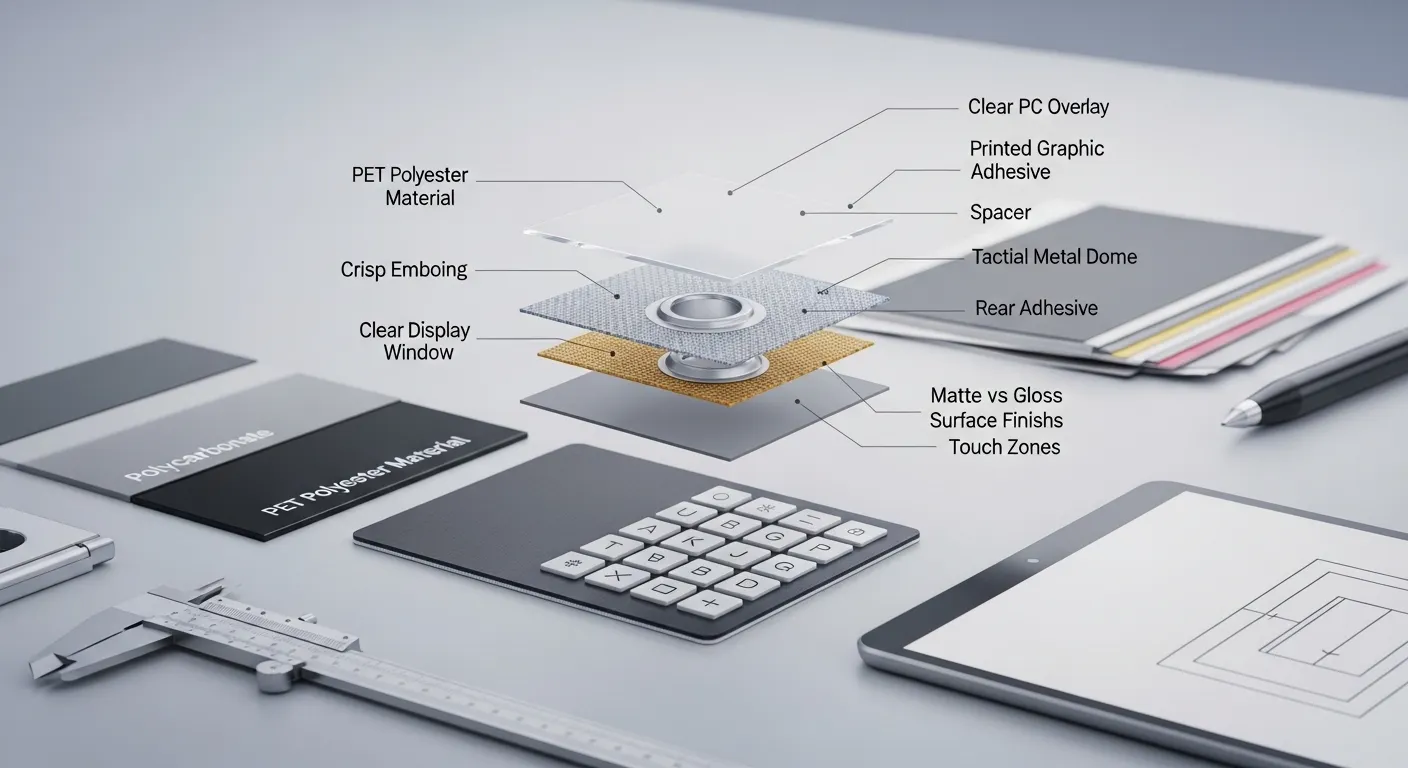
Choose a polycarbonate membrane switch overlay when appearance, clarity, and formed details matter more than maximum chemical resistance. PC is often selected for control panels that need sharp printed graphics, clear display windows, LED indicator areas, or deeper embossed button zones.
Polycarbonate is also easier to process for many graphic overlay designs. It can support clean die-cutting, attractive surface finishes, and crisp embossing for tactile zones. For lower-to-medium duty interfaces, this can make PC a practical overlay option.
PC is commonly considered for:
However, PC should not be chosen only because it looks good. If the product will face solvents, disinfectants, oil, harsh cleaners, outdoor sunlight, or repeated heavy actuation, PET polyester may be safer.
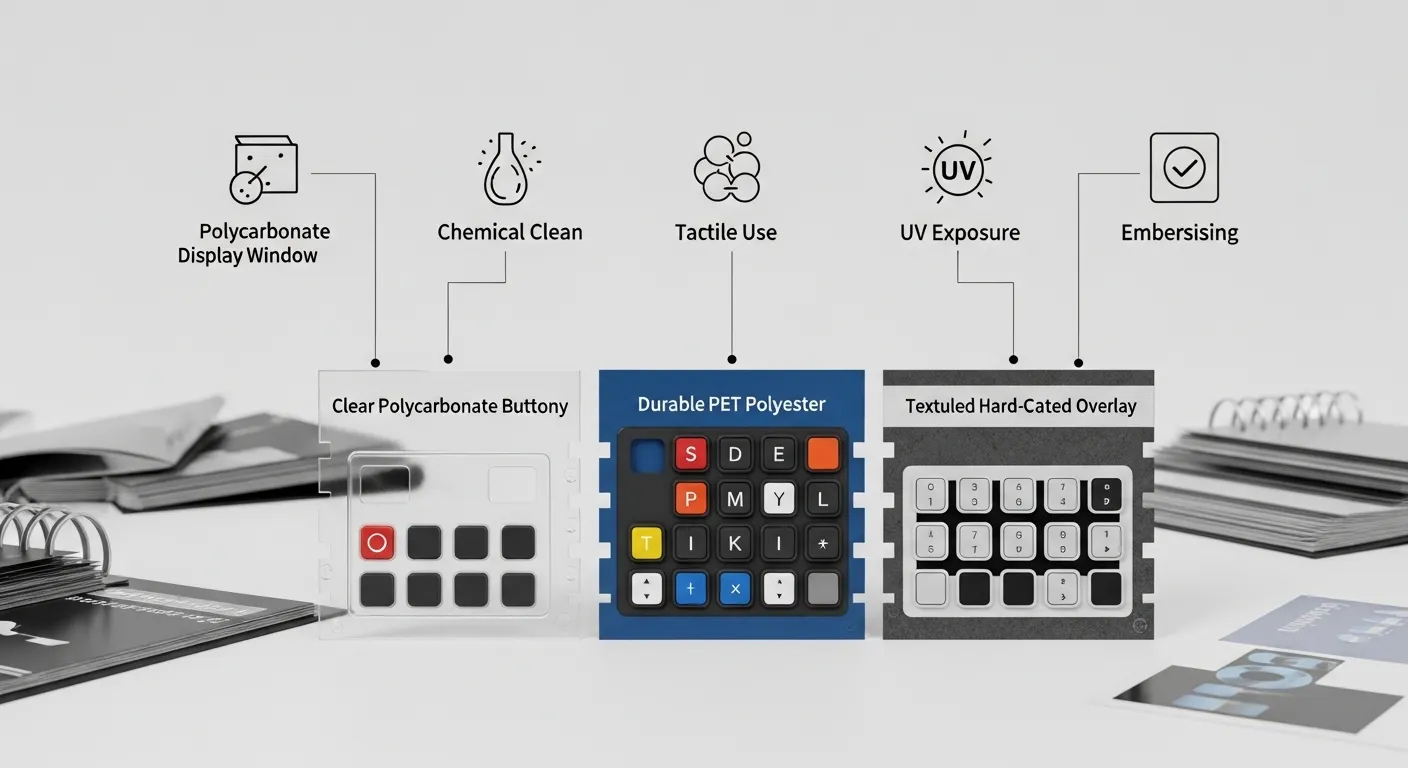
The overlay material affects more than the surface look. It changes durability, chemical behavior, tactile feel, window clarity, embossing design, and long-term field risk.
| Buyer requirement | Polycarbonate overlay | PET polyester overlay | Textured / hard-coated option | Better fit |
|---|---|---|---|---|
| Clear display window | Strong choice for optical clarity | Good, depending on film and finish | Hard-coated clear window can improve surface durability | PC or hard-coated PC |
| Heavy tactile key use | Works for some designs, but needs review | Usually stronger for flex and repeated actuation | Texture can protect touch zones | PET |
| Chemical cleaning | Sensitive to some chemicals | Usually better chemical resistance | Hardcoat may help, but must be checked | PET |
| Crisp embossing | Strong choice for deeper or cleaner embossing | Possible, but design limits may differ | Textured emboss can improve feel | PC |
| Outdoor or UV exposure | Needs suitable film, ink, and finish review | Often safer with correct material system | UV-stable films and inks may be needed | Project-specific |
| Premium visual finish | Strong for gloss, matte, and clear windows | Strong for durable industrial panels | Texture helps reduce fingerprints and glare | PC or textured PET |
| Cost-sensitive industrial build | May cost more depending on film and coating | Often cost-effective for durable overlays | Coatings add cost | PET or project-specific |
| IP-rated sealed panel | Material matters, but sealing design matters more | Material matters, but sealing design matters more | Finish must match adhesive and housing | Depends on full stack-up |
For many OEM projects, the real choice is not simply “PC or PET.” It is “PC, PET, hard-coated PC, textured PET, or a mixed finish design.” Niceone can review the overlay drawing, display window, embossing zones, and use environment before recommending the material stack.
If your build has RoHS documentation requirements, confirm material compliance during the RFQ stage. You can also review Niceone’s RoHS-related guidance.
PET polyester often outperforms PC when the overlay must survive aggressive use. If the membrane keypad will be pressed thousands of times per shift, cleaned with disinfectants, exposed to industrial fluids, or installed outdoors, PET deserves close review.
Polyester is often preferred for:
This does not mean PC is weak. It means PC should be specified carefully. A hard-coated, textured, or protected PC overlay may solve some surface issues, but chemical compatibility still needs review.
For engineering teams, the safest approach is to describe the real exposure conditions. Do not only send a drawing. Send cleaning chemicals, expected touch frequency, sunlight exposure, target finish, and the required sealing level.
Yes, polycarbonate can work well for embossed tactile keys, especially when the buyer wants a crisp visual and tactile shape. PC can support pillow embossing, rim embossing, rail embossing, and raised button areas, depending on the overlay design and tooling.
Embossing should be matched with the complete switch structure. The overlay, spacer, metal dome or polydome, circuit layer, adhesive, and housing all influence the final feel.
For tactile zones, confirm:
If the keypad is expected to receive frequent actuation, PET may be better. If the keypad needs strong visual definition, display windows, and moderate actuation, PC may be a good fit.
The surface finish can change the buyer’s experience as much as the base material. A glossy PC overlay may look clear and premium, but it can show fingerprints or scratches in active touch zones. A textured finish can reduce glare and improve handling.
Common finish choices include:
If the design includes display windows and tactile keys on the same overlay, a selective finish may be useful. For example, the window area may stay clear, while the button area uses texture.
If the project has UL-related material expectations, avoid assuming that a base film rating equals a finished membrane switch certification. Niceone can review the requirement during specification. For more context, see Niceone’s UL-certified membrane switch guidance.
The overlay sits at the top of the membrane switch, but it affects the whole assembly. A PC overlay may require different decisions for adhesive, spacer design, embossing, backlighting, and sealing.
A typical custom build may include:
IP performance depends on the complete mechanical design, not only the overlay material. Tail exits, adhesive coverage, spacer venting, housing flatness, and edge sealing can all affect waterproof or dust-proof performance.
This is why material selection should happen before final tooling. Changing from PC to PET late in the project can affect embossing, window clarity, surface finish, and tactile feel.
Use these questions before sending your drawing for review.
| Question | If yes, consider | Why it matters | RFQ note to send Niceone |
|---|---|---|---|
| Does the overlay need a clear display window? | PC or hard-coated PC | PC can support strong visual clarity | Window size, display type, transparency needs |
| Will operators press the keys very often? | PET | Flex and actuation life become critical | Estimated use frequency and tactile feel |
| Will the panel face chemicals or disinfectants? | PET or tested coating | PC may be sensitive to some chemicals | Cleaner names, concentration, cleaning method |
| Is deep or crisp embossing important? | PC | PC is often strong for formed details | Emboss style, height, button layout |
| Will the product be used outdoors? | Project-specific film and ink | UV and weather exposure affect overlay life | Outdoor level, sunlight exposure, IP target |
| Are RoHS, UL, or material documents required? | Confirm during RFQ | Documentation depends on selected materials | Required standard, market, and file format |
This matrix is not a replacement for engineering review. It helps your team prepare a better RFQ and avoid material changes after samples are made.
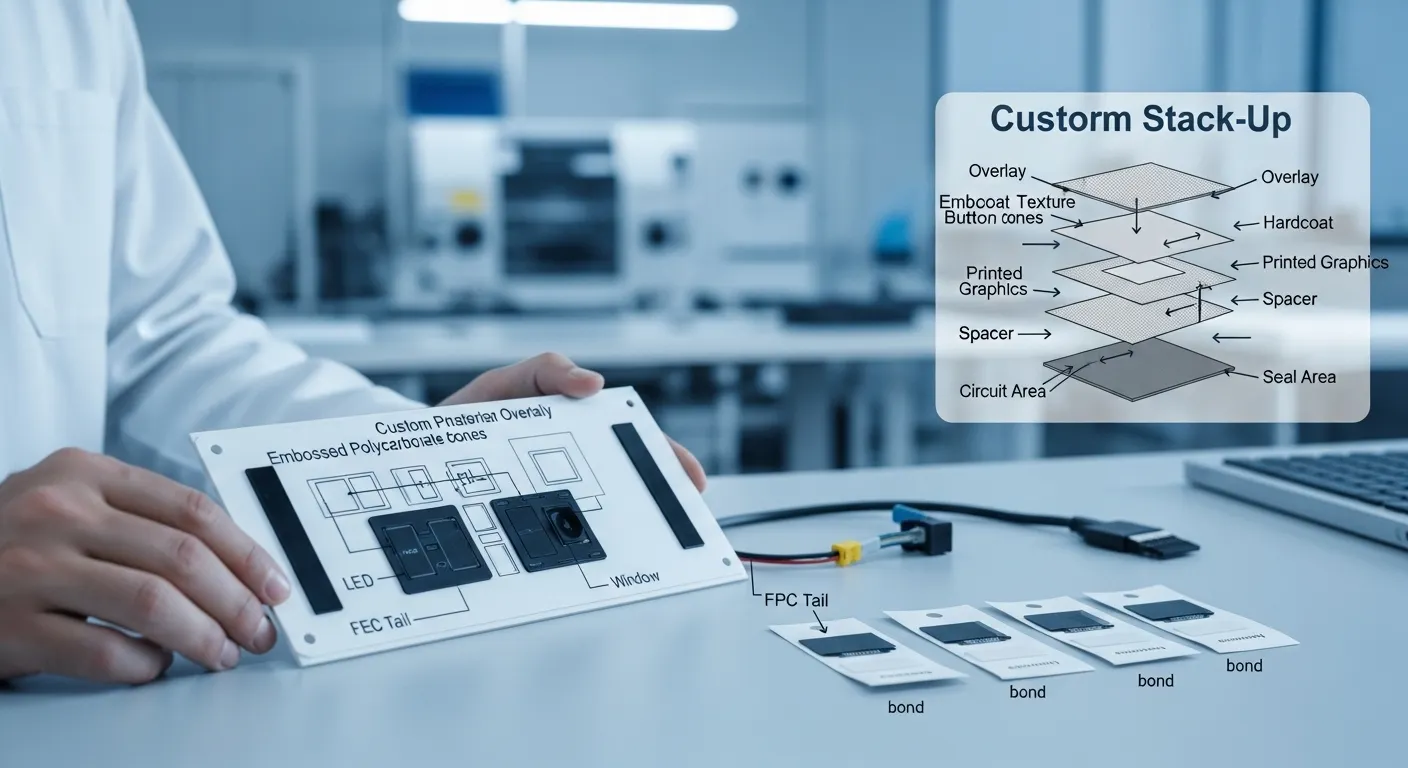
For a PC vs PET overlay recommendation, send the use conditions with the drawing. A small detail, such as disinfectant use or direct sunlight, can change the material choice.
Include:
If you are still testing the design, review Niceone’s sample request process.
Yes, but it needs review. PC can work for some tactile designs, especially with crisp embossing. For very frequent key presses, PET polyester is often the safer overlay choice.
Not always. Gloss PC can show scratches. Textured or hard-coated PC can improve surface protection, but the right choice depends on the touch zone, cleaning method, and finish.
PC may be sensitive to some chemicals. If the panel needs disinfectants, solvents, oils, or frequent cleaning, PET or a tested coating should be reviewed first.
PC is often better for clear windows, sharp graphics, crisp embossing, display areas, and premium visual finish. PET is usually better for harsh use and chemical exposure.
Yes, but indirectly. IP rating depends on the full stack-up, adhesive, tail exit, housing seal, spacer design, and edge construction, not only the overlay film.
Send the drawing, artwork, target finish, display window details, embossing needs, cleaning conditions, touch frequency, IP target, connector details, and any compliance requirements.
Send Niceone-Keypad your drawing, artwork, application environment, display window needs, embossing style, cleaning method, IP-rating target, connector details, and compliance requirements. Our team can review whether polycarbonate, PET polyester, textured film, or a hard-coated overlay is the better fit for your custom membrane switch build, with production support from our Dongguan factory and customer communication through our Connecticut office.
Do you have any questions, or would you like to speak directly with a representative?

