

Contact
Write to Us And We Would Be Happy to Advise You.
Do you have any questions, or would you like to speak directly with a representative?
By Fariha
Each membrane switch design example in this gallery captures five spec decisions that define a build: overlay material, dome force (if tactile), IP sealing rating, backlighting type, and circuit configuration. These decisions don’t exist in isolation — they’re driven by the operating environment, operator profile, and product lifecycle of a specific industry application. This page documents 12 real-world membrane switch configurations across medical, food-processing, marine, automotive, and industrial verticals, with a spec snapshot for each build. If you’re an OEM design engineer or hardware procurement manager kicking off a new build, use these examples to benchmark your own spec before drafting a brief or sending an RFQ to our Dongguan design team.
Before diving into the examples, engineers who need a primer on how membrane switch layers work together can review how a membrane switch works before reading the spec breakdowns below.
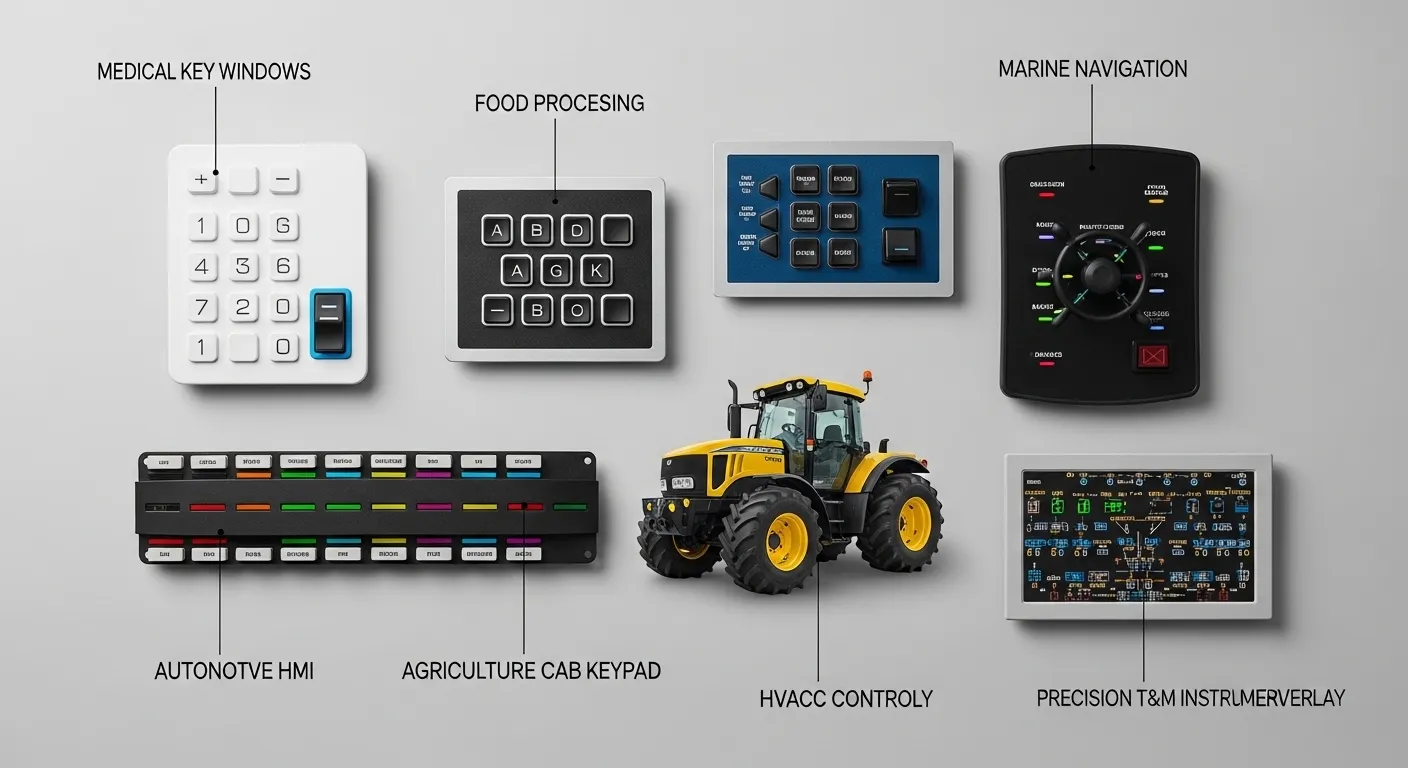
A spec sheet lists what a switch can do. A design example shows what a switch was built to do — and why. The overlay material selection on a medical infusion pump has nothing to do with the overlay choice on a food slicer, even though both products may call for an IP-rated, tactile, polyester-overlay panel.
Five variables define every build documented below:
Design driver: Gloved-operator actuation in a disinfectant-exposed clinical environment.
A medical infusion pump keypad handles daily disinfectant wipe-downs, potential drip exposure, and consistent operation by clinicians wearing latex or nitrile gloves. The overlay must survive repeated chemical contact without delaminating or hazing. Dome force is calibrated low enough for gloved fingers but distinct enough to prevent accidental actuation during patient handling.
| Spec | Value |
|---|---|
| Overlay material | PET 0.125 mm with chemical-resistant hardcoat |
| Dome force | 150–200 g (light glove, precision actuation) |
| IP rating | IP67 |
| Backlighting | LED indicator windows or none |
| Circuit type | Silver ink on PET flex, ZIF tail connector |
Key design decision: PET over PC. PC overlays can craze and crack under repeated alcohol or chlorhexidine exposure. A PET overlay with a chemical-resistant hardcoat is the standard starting point for any medical surface that sees clinical disinfectants.
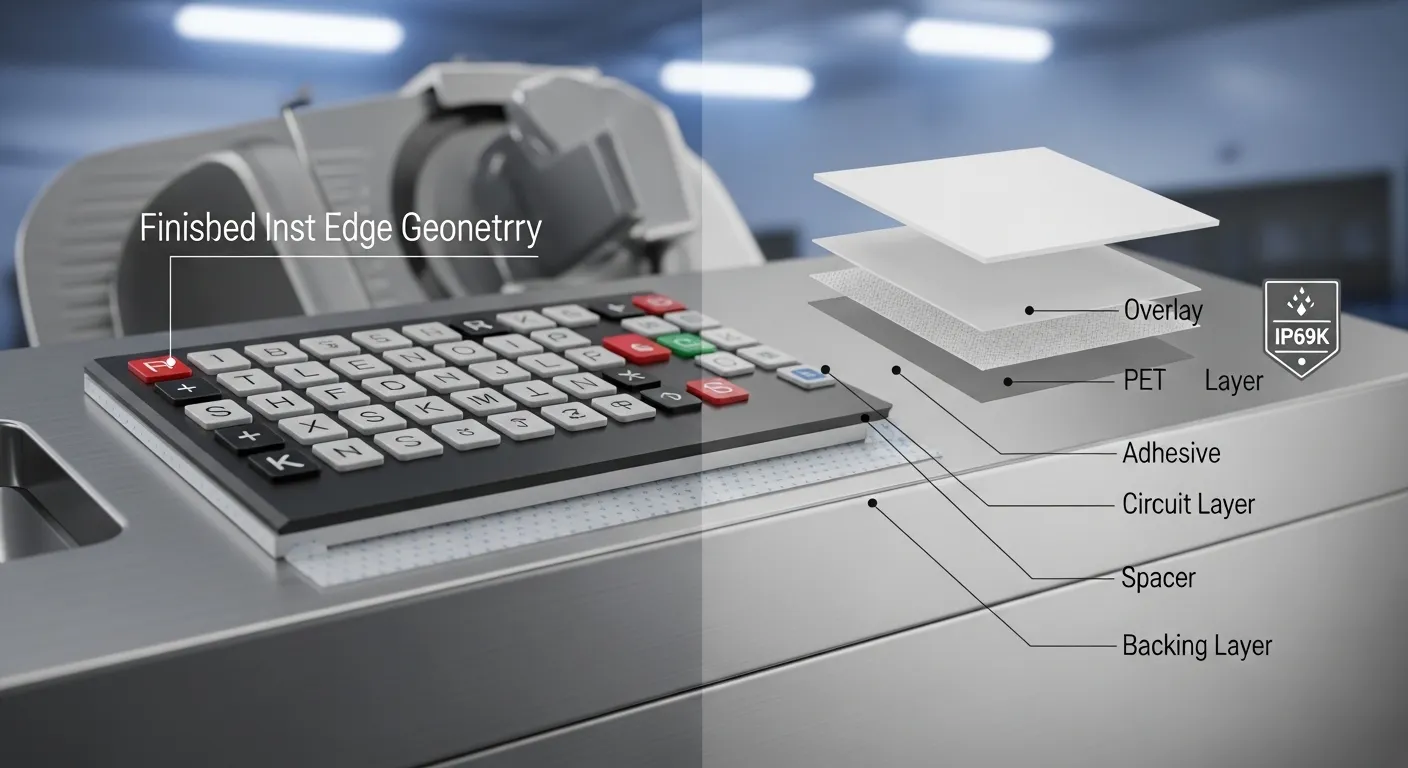
Design driver: Daily high-pressure, high-temperature caustic washdown — not just splash resistance.
This is where IP67 is the wrong spec. Food-processing equipment undergoes daily cleaning at 80–100 bar pressure, often with 80 °C water and alkaline detergent. IP67 tests submersion — not high-velocity spray. IP69K is the correct rating for this application, and it’s one of the most common spec errors engineers carry into a first RFQ.
| Spec | Value |
|---|---|
| Overlay material | PET with UV-stable, chemical-resistant hardcoat |
| Dome force | 280–350 g (heavy glove, operator confirmation needed) |
| IP rating | IP69K |
| Backlighting | Minimal or none; indicator LED only |
| Circuit type | Sealed FPC, perimeter adhesive bond to stainless housing |
Key design decision: Sloped top edge geometry and full-perimeter seal adhesive prevent standing water and cleaning-agent pooling at the membrane edge. This is a mounting and geometry decision, not just a material one.
Design driver: Salt spray, UV degradation, and night navigation in a high-vibration environment.
A marine helm membrane panel faces sustained UV exposure, salt spray, and operator use with wet, gloved hands. IP67 is appropriate here — the switch won’t be submerged, but it will take direct spray. Backlighting is critical: navigation legends must remain legible at night without compromising the overlay’s UV stability.
| Spec | Value |
|---|---|
| Overlay material | PET with UV-stable hardcoat |
| Dome force | 300–400 g (gloved, rolling deck) |
| IP rating | IP67 |
| Backlighting | EL panel or light guide film for even night illumination |
| Circuit type | FPC with strain-relief tail exit for vibration |
Key design decision: EL backlighting over individual LEDs. In a marine helm application, even legend illumination across the full overlay is more readable at low light angles than point-source LED legends. EL panels also eliminate hotspots under translucent overlay windows.
Design driver: High cycle life, cabin-matched aesthetics, and EMC compliance for an OEM assembly.
Automotive HMI membrane keypads operate ungloved, in climate-controlled cabins, but demand tight overlay tolerances for flush panel integration and consistent dome feel across production batches. ESD shielding is required to meet EMC requirements for in-vehicle electronics. Backlighting must match cabin ambient color temperature.
| Spec | Value |
|---|---|
| Overlay material | PC 0.125 mm, selective matte/gloss texture |
| Dome force | 280–320 g (bare finger, precise feel) |
| IP rating | IP54 (splash, no immersion) |
| Backlighting | LED with color-filter ink (2700–6500 K per OEM spec) |
| Circuit type | PCB-backed or silver ink with conductive ESD shield layer |
Key design decision: Panel rigidity affects perceived dome force. A metal sub-panel or PCB backing stiffens the assembly and can make a 300 g dome feel closer to 380 g at the fingertip. Our engineering team specifies dome force after confirming the mounting substrate — a step often missed at initial RFQ. See our page on membrane switch actuation force for a full breakdown of how panel stiffness changes what the operator actually feels.
An indoor panel on a commercial HVAC unit sees moderate temperatures, occasional condensation, and ungloved operator use. IP54 is typically sufficient. Overlays are PC in most HVAC applications — lower cost, easy to emboss, sufficient for light chemical exposure.
| Spec | Value for HVAC |
|---|---|
| Overlay | PC 0.175 mm |
| Dome force | 280–300 g |
| IP rating | IP54 |
| Backlighting | LED indicators |
An outdoor tractor cab keypad contends with vibration, UV exposure, dust, and occasional mud splash. Vibration environments can cause tactile switches to register false actuations. Non-tactile configuration with LED/audio feedback is the safer choice for high-vibration duty. PET overlay is standard for UV stability.
| Spec | Value for Agricultural |
|---|---|
| Overlay | PET with UV-stable hardcoat |
| Dome force | Non-tactile (LED + audio confirmation) |
| IP rating | IP67 |
| Backlighting | LED with rugged viewing angle |
For agricultural builds where vibration modifies how dome actuation feels in use, the actuation force explained page covers the system-level stiffness factors that change perceived feel from spec to final assembly.
A benchtop instrument panel operates in a controlled environment with bare-finger use and fine legend printing for unit labels and mode indicators. IP54 is sufficient. Precision printing resolution and legend durability under calibration-cycle use are the defining constraints.
| Spec | Value for T&M |
|---|---|
| Overlay | PET 0.125 mm, hardcoat |
| Dome force | 200–260 g (precision, bare finger) |
| IP rating | IP54 |
| Backlighting | None or minimal LED indicator |
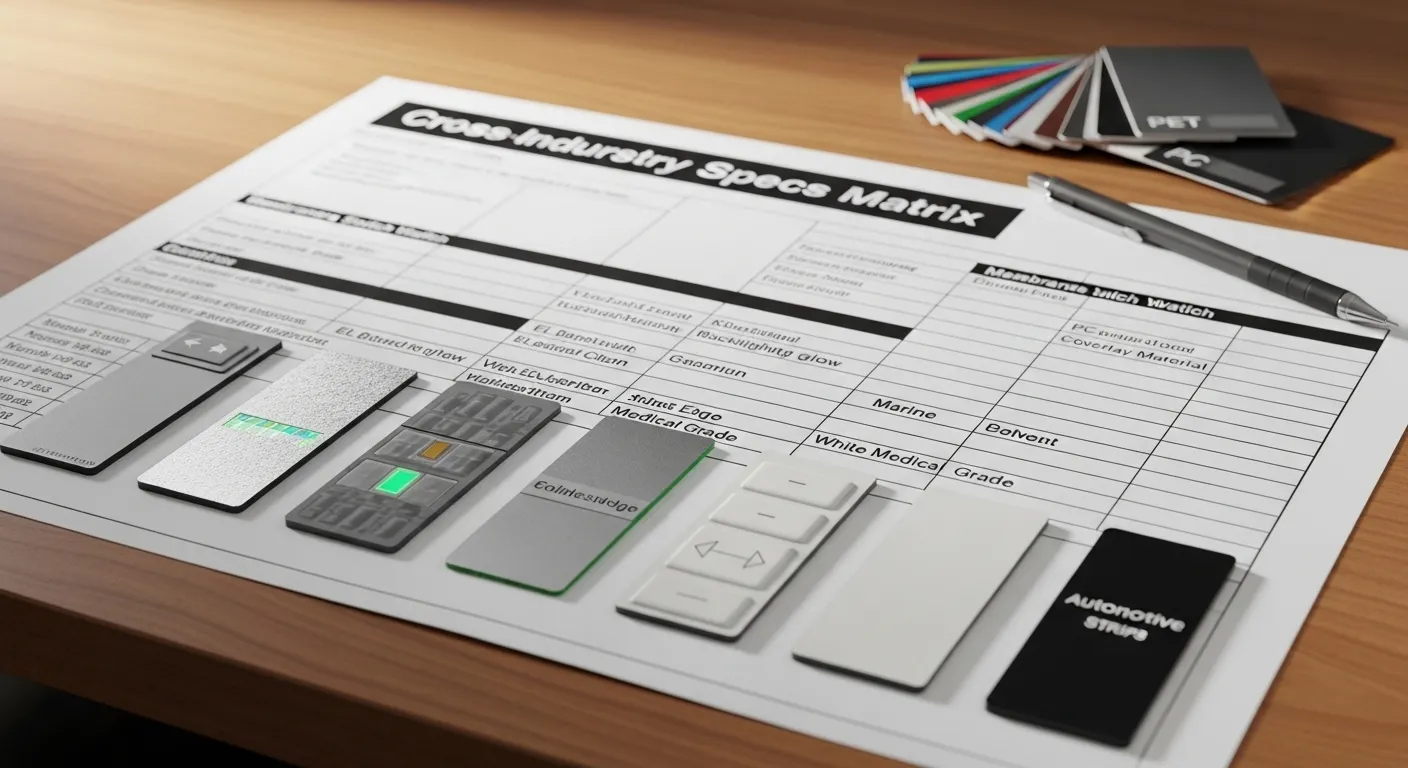
Use this table to locate the row closest to your application and identify which spec decisions need locking before briefing a supplier.
| Industry | Overlay Material | Dome Force | IP Rating | Backlighting | Key Decision |
|---|---|---|---|---|---|
| Medical infusion pump | PET 0.125 mm + hardcoat | 150–200 g | IP67 | LED indicators / none | Chemical-resistant hardcoat; ZIF tail |
| Food slicer / meat processing | PET + UV-stable hardcoat | 280–350 g | IP69K | Minimal / none | IP69K not IP67; sloped geometry |
| Marine helm | PET + UV-stable hardcoat | 300–400 g | IP67 | EL panel / light guide film | Even night illumination |
| Automotive HMI | PC 0.125 mm, textured | 280–320 g | IP54 | LED + color filter | ESD shield; panel stiffness offset |
| HVAC control | PC 0.175 mm | 280–300 g | IP54 | LED indicators | Low-cost PC acceptable |
| Agricultural (tractor cab) | PET + UV-stable hardcoat | Non-tactile | IP67 | LED + audio | Vibration → non-tactile |
| Test & measurement | PET 0.125 mm + hardcoat | 200–260 g | IP54 | None / LED | Fine legend resolution |
After identifying your closest benchmark row, the next step is working through the Niceone membrane switch design service flow to move from a spec matrix to a reviewed, production-ready file.
Three spec decisions constrain everything that follows in a membrane switch design:
1. IP rating — determines adhesive type, seal geometry, tail exit location, and mounting perimeter. Changing the IP requirement after tooling begins can invalidate the adhesive stack and housing cutout.
2. Overlay material — PC and PET require different embossing tooling. PET hydroforming tools are more expensive than PC embossing dies. Lock overlay material before placing any tooling order.
3. Dome force — must be evaluated against the mounting substrate and operator glove profile, not just the dome component spec. A 300 g dome assembled on a 2 mm aluminum panel will feel measurably stiffer than the same dome on a 0.5 mm PET backer.
Engineers who have locked these three variables are ready to send a prototype-ready brief. The fastest way to validate a spec combination before production commitment is a functional prototype — see how the Niceone prototype service process works.
IP69K is the correct rating for daily high-pressure, high-temperature washdown applications — food slicers, meat grinders, dairy processing equipment. IP67 tests submersion to 1 m; it does not qualify a switch for 80 °C caustic spray at 80–100 bar. Specifying IP67 on food-processing equipment is one of the most common membrane switch design errors.
Standard bare-finger operation: 180–300 g. Light latex or nitrile glove (medical, clean room): 280–400 g. Heavy industrial or cut-resistant glove (food processing, agriculture): 400–600 g. Always confirm your mounting substrate — panel stiffness adds perceived resistance beyond the dome’s rated trip force.
PET (polyester) delivers superior chemical resistance and cycle life — it’s the default for food, marine, medical, and outdoor agricultural applications. PC (polycarbonate) is lower cost, easier to emboss, and acceptable for indoor, low-chemical environments like HVAC and T&M instruments. If you’re unsure, specify PET and review with your supplier.
Yes. LED integration within the circuit layer does not break the IP seal. EL panel backlighting is fully compatible with IP67 designs. Deadfront overlays — opaque at rest, illuminated when activated — are the standard approach for sealed backlit panels in marine and medical builds.
A PCB-backed membrane switch adds a rigid printed circuit board beneath the standard flex circuit stack. This increases structural rigidity, supports SMD components (LED drivers, microcontrollers), and resists vibration-induced connector fatigue. Use PCB-backing for automotive HMI, agricultural equipment, and any build requiring integrated electronics or high-vibration durability.
If you’ve identified the closest benchmark from the examples above, you have enough to start a productive design conversation.
Send our Dongguan design team or our Redding, CT office the following when you reach out:
Contact Niceone-Keypad at https://www.niceone-keypad.com to submit your spec, request a prototype quote, or schedule a design review with our engineering team.
Do you have any questions, or would you like to speak directly with a representative?

