

Contact
Write to Us And We Would Be Happy to Advise You.
Do you have any questions, or would you like to speak directly with a representative?
By Fariha
Most membrane switch panel failures cannot be permanently repaired. Cracked silver traces, flattened metal domes, delaminated circuit layers, and corrosion from liquid ingress all require a replacement panel — not a patch. The only repairs with a lasting result are cleaning dirty contacts with isopropyl alcohol and re-adhering a lifted graphic overlay when the circuit layer underneath is still intact. If you are an appliance owner, field service technician, or maintenance engineer holding a non-functional panel, this guide walks you through a six-step diagnostic to determine exactly which category your failure falls into — and what to do next. When replacement is the right call, Niceone-Keypad’s design team in Dongguan can reverse-engineer a matched replacement from your original panel or a dimensioned drawing.
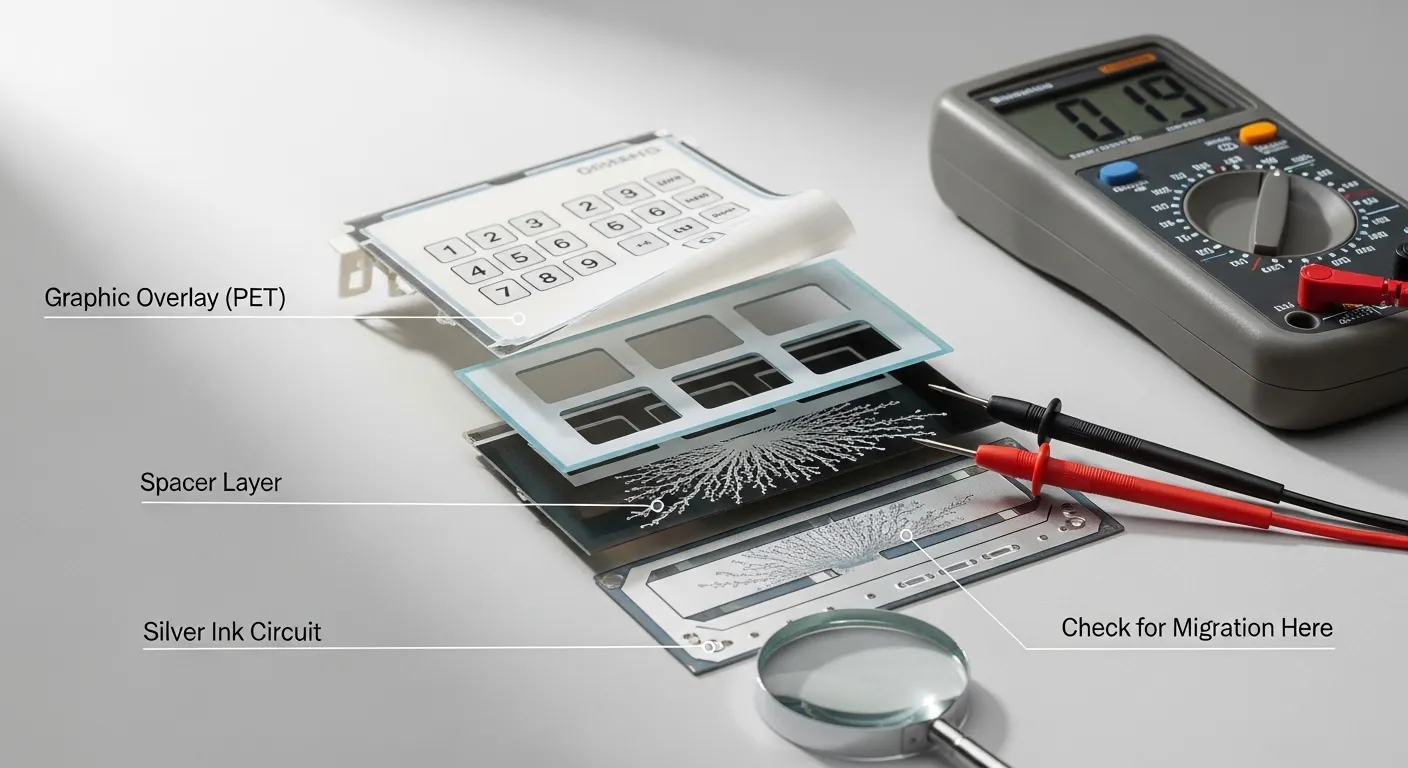
Before opening a device or ordering anything, understand the two categories of membrane switch failure.
Repairs that hold:
Failures that are not durably repairable:
| Failure Mode | Repairable? | Why Repair Fails or Holds | Replace Urgency |
|---|---|---|---|
| Dirty or oxidized contacts | ✅ Yes — clean with IPA | Surface contamination only | Low |
| Lifted overlay (adhesive failure only) | ✅ Conditionally | Re-adhere if circuit is intact | Low–Medium |
| Loose connector at ZIF socket | ✅ Yes | Re-seat and inspect pins | Low |
| Single failed LED (PCB switch) | ✅ Sometimes | Requires desoldering skill | Medium |
| Cracked or creased silver trace | ❌ Temporary only | Paint bridges surface, not the fracture interior | High |
| Silver migration between traces | ❌ No | Electrochemical — irreversible | Immediate |
| Flattened metal dome | ❌ No | Material fatigue — cannot re-spring | High |
| Delaminated spacer or circuit layer | ❌ No | Geometry change — contact is lost | High |
| Liquid ingress with corrosion | ❌ No | Trace corrosion is permanent | Immediate |
| Torn graphic overlay with circuit damage | ❌ No | Full assembly compromised | High |
Work through these steps in order. A positive result at step 4, 5, or 6 means the panel must be replaced — no repair method changes that outcome.
Step 1 — Visual check of the overlay.Is the graphic surface torn, cracked, or showing ink peeling away from the substrate? Overlay cosmetic damage alone does not mean the circuit is gone. Overlay damage combined with visible delamination below the surface means the spacer layer may be compromised — move to Step 3 before concluding.
Step 2 — Check the tail and connector.Pull the ZIF connector fully out and re-seat it. Inspect the tail for sharp creases, especially within 25 mm of the connector. A creased tail is one of the most common causes of sudden panel failure and one of the most commonly overlooked. If re-seating restores all keys, the panel is reusable.
Step 3 — Multimeter continuity test.With the panel disconnected, probe each key contact pair. Note every open circuit. A single open key that corresponds to a visible crease or crack in the tail points to a silver trace fracture — go to Step 5. Multiple simultaneous open contacts across unrelated keys suggest more widespread circuit failure.
Step 4 — Dome tactile test.Press each key slowly with a fingertip. A healthy metal dome produces a distinct tactile snap at the actuation point. A flat or inverted dome offers no snap — the key either registers inconsistently or not at all. If the snap is absent, the dome has collapsed. No cleaning or repair restores it. For reference on what healthy actuation force feels like across dome types, see Niceone’s guide on membrane switch actuation force.
Step 5 — Inspect for silver migration.Under a magnifying glass or phone camera macro mode, look for gray or black branching (dendritic) patterns growing between adjacent conductive traces. This is silver migration — an electrochemical failure caused by moisture combined with a voltage differential across traces. It is not a mechanical break. No conductive paint bridges it. Any panel showing silver migration must be replaced.
Step 6 — Check for liquid ingress.Open the panel housing and examine the spacer layer and circuit layer for brown or white tide lines — the residue left when liquid evaporates after ingress. These marks indicate that conductive traces have already begun to corrode. Even if continuity appears acceptable today, corrosion will continue under the surface.
Decision gate: If Step 4, 5, or 6 returned a positive result, stop. The panel is not repairable. Ordering a replacement is the faster and more economical path.
Conductive silver paint is the most common DIY repair for broken membrane switch traces. It can restore function temporarily — sometimes for weeks. It does not last.
Membrane switch circuits are printed with silver-ink paste. The conductive path depends on a continuous, embedded trace with consistent cross-section. When a trace fractures — especially from a creased tail or from repeated bending — the break runs through the full depth of the ink layer, not just the surface. Conductive paint bridges the top surface only. It has higher contact resistance than the original trace, degrades faster under flex cycling, and the underlying fracture continues to propagate.
For sharp crease damage, the fracture also runs through the PET or polyester substrate. No surface application reaches that level. Real-world reports from engineers consistently describe silver paint repairs working briefly, then failing again — often in a worse location than the original break.
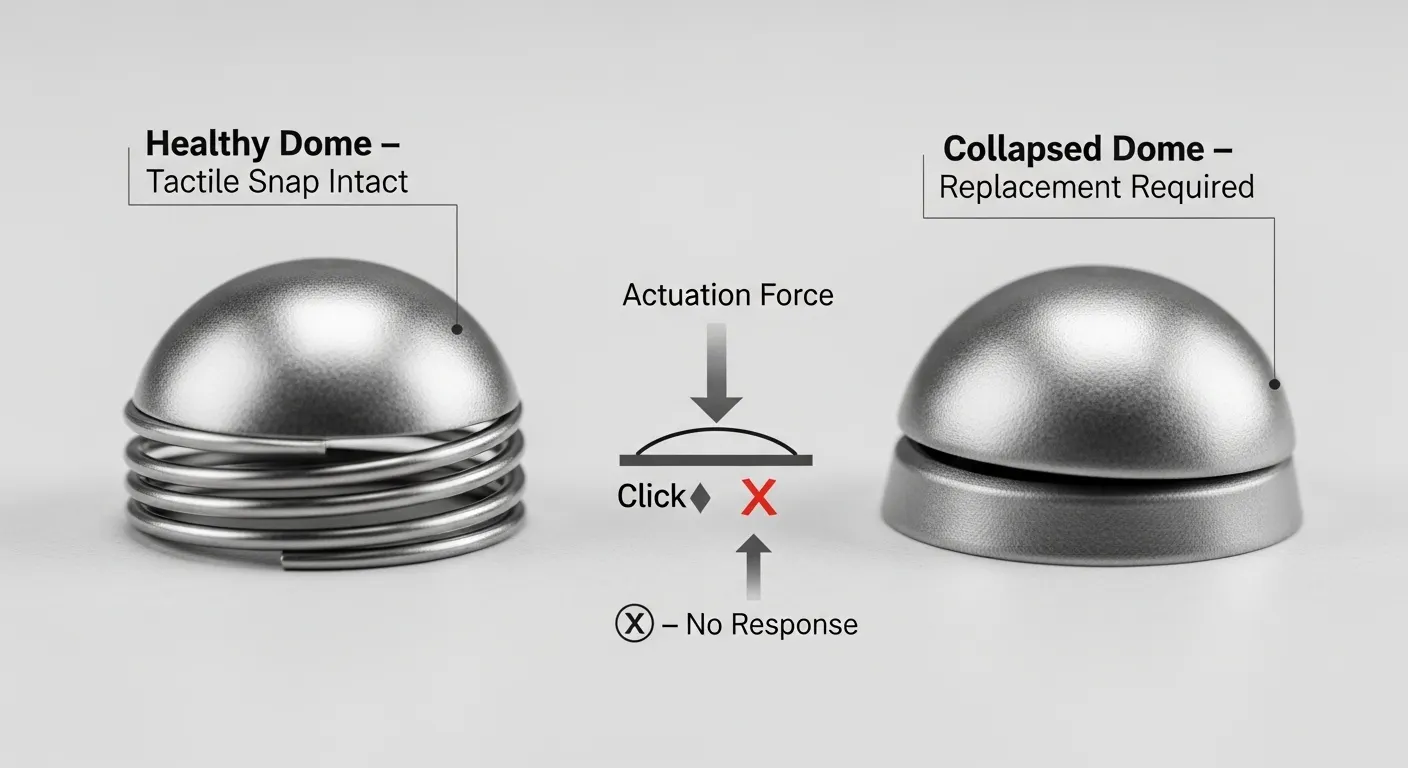
A metal dome’s function is mechanical: it snaps down to bridge two circuit traces and snaps back to provide tactile feedback and ensure circuit opening. Both depend on the dome’s spring geometry — a precise curvature held by the material’s elastic memory.
Flattening happens through repeated actuation beyond the dome’s designed force range, pressing the panel on an uneven surface, or physically bending the assembly. Once a dome’s geometry collapses past its elastic limit, it enters plastic deformation. The spring geometry is permanently lost.
The difference between an inverted dome and a fully flat dome matters: an inverted dome may re-snap under pressure. A fully flat dome will not recover. If pressing a key produces no tactile click at all, assume the dome is flat, not inverted. This failure is commonly misread as a trace problem — the symptom (no response) is identical. The six-step diagnostic above separates them. For a working understanding of actuation force ranges and what distinguishes a healthy dome response from a degraded one, see Niceone’s actuation force reference.
Delamination is not one problem — it is two distinct failures with different repair outcomes.
Overlay delamination refers to the top graphic layer lifting at its edges due to adhesive failure from UV exposure, moisture, or age. If the circuit layer underneath is confirmed intact by a continuity test, re-adhering with a compatible pressure-sensitive adhesive can restore both appearance and environmental sealing — at least for a low-criticality application. This is the one overlay repair worth attempting.
Circuit-layer or spacer delamination is a different problem. When the spacer layer separates from the bottom circuit layer, the contact geometry between dome, circuit trace, and contact pad changes. Keys become intermittent. This cannot be repaired without fully disassembling a laminated stack that will not survive disassembly intact.
One more consequence worth noting: any delamination — overlay or otherwise — breaks the panel’s environmental seal. If your original panel was IP65, IP66, or IP67 rated, it is no longer rated after delamination, regardless of how the re-adhesion looks visually.
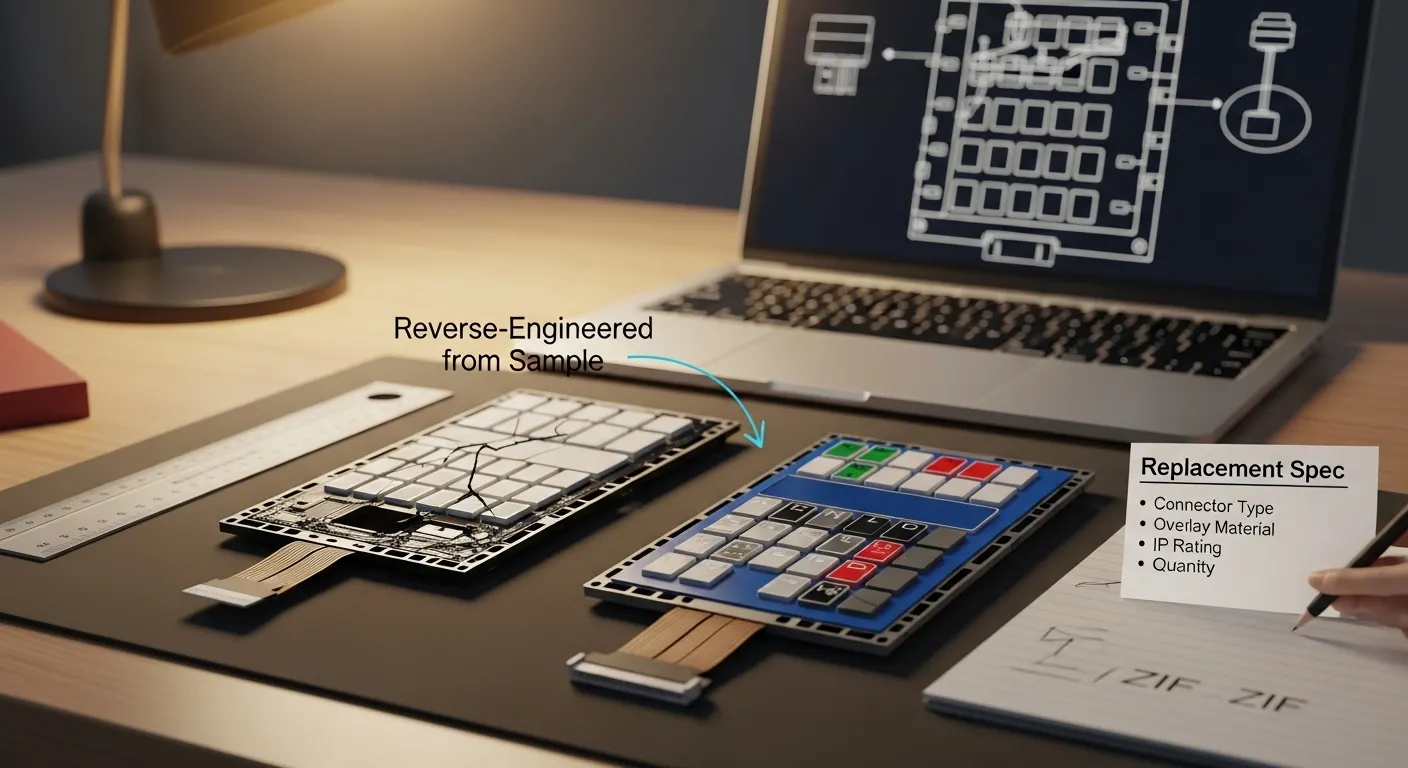
Once you have confirmed the panel must be replaced, the fastest path is to contact Niceone-Keypad’s design team. Our engineers in Dongguan can reverse-engineer a matched replacement from a physical sample — even a damaged one — or produce a panel from drawings alone.
Replacement panel identification checklist:
The more of this you can provide upfront, the faster our team can confirm a matched specification. For a full view of how the design-to-production process works, see our membrane switch design service flow.
Our Dongguan factory produces the full membrane switch stack in-house — graphic overlay printing, circuit layer, spacer, adhesive lamination, metal dome assembly, backlighting integration, and connector attachment. That matters for aftermarket replacement work because the panel that arrives matches the original in every layer, not just the visible surface.
The US office in Redding, Connecticut handles North American customer coordination. File review, design approvals, and specification confirmation happen during overlapping business hours — no 12-hour delay on critical questions. For buyers who need a prototype before committing to a replacement run, our prototype service produces a verified sample before full production begins: membrane switch prototype service process.
You can also view examples of custom membrane panels our team has produced across different applications and configurations at our membrane switch design examples gallery.
No — not permanently. Conductive paint restores surface conductivity temporarily but cannot repair the interior fracture of a printed silver trace. Contact resistance is higher than the original, and the repair degrades under flex cycling. For any panel that must operate reliably, replacement is the correct answer. Silver paint repairs typically last weeks, not months.
Silver migration appears as gray or black branching, tree-like (dendritic) patterns growing between adjacent conductive traces on the circuit layer. It is caused by moisture combined with a voltage differential. It is electrochemical — not a mechanical break — and cannot be reversed by cleaning or any repair material. Any panel showing silver migration requires replacement.
Press each key slowly. A healthy metal dome produces a distinct tactile snap at the actuation point. A flat dome produces no snap — the key feels mushy or does not register. Cleaning the contact surface will not restore the snap. If the snap is absent, the dome has collapsed and the panel needs replacement.
Yes. Send the damaged panel as a physical sample — our design team reverse-engineers the dimensions, layer stack, connector spec, and graphic layout from it. If no physical sample exists, a dimensioned photo or drawing works as a starting point. We confirm the full specification with you before production begins.
Custom replacement panels are built to match the original’s dimensions, key layout, overlay material, surface finish, and graphic design. Color and finish are confirmed during the design approval phase before production. If your original had a specific tactile dome force or IP sealing requirement, specify that in your inquiry so we can match it in the replacement spec.
If your diagnostic points to a failure mode that cannot be repaired — fractured trace, collapsed dome, silver migration, or corrosion — the right move is a matched custom replacement, not a repair attempt that will fail again.
Send Niceone-Keypad’s team the following:
Contact our team via the Niceone-Keypad website or reach the US office directly in Redding, CT. Our Dongguan engineering team will review your sample or spec and return a matched replacement quotation.
Do you have any questions, or would you like to speak directly with a representative?

